What distributed development teams need is this: A ‘single source of truth’ for software assets, one that is available to any team or individual, anywhere on the planet, whilst maintaining the highest levels of performance for all.
Today, 10/04/2020, new robotics pages went live on ubuntu.com. We want to show our involvement, our stance and our support for ROS and robotics. These three pages cover what we do in the robotics space, Canonical’s involvement with ROS and Open Robotics, and the relevance of community in the field of robotics. Our intention is to be another entry point for new users to involve themselves and to enable them to build robots with ROs on Ubuntu.
Algorithms are at the heart of the technologies we use in virtually every facet of our daily lives — formulas and processes that help us connect, solve problems and accomplish amazing things. Things like better speech recognition and landing an autonomous rocket on a drone ship, or giving us really great Netflix recommendations. But an algorithm is just a set of rules or a set of tasks to perform given a certain input.
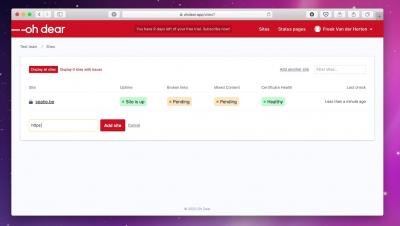
Learn how this Livewire powered screen works:
https://freek.dev/1622-replacing-web-sockets-with-livewire
Do all your synthetic monitors include a content check? Why not? Content checks are free with all our monitor types, but for the most part, Uptrends users underutilize content checks. In this article, we talk about why content checks are important for your monitoring, and we touch on some tips to help you pick the content checks that work best for you.
Over 44 records are stolen per second every day due to data breaches, and according to the Risk Based Security Research report published in 2019, databases are the top most targeted assets for malicious actors to exploit organizations’ confidential data. Often, organizations don’t realize their databases have been compromised for months. Once sensitive data is leaked, the damage can’t be undone.
Every JavaScript project starts ambitiously, trying not to use too many NPM packages along the way. Even with a lot of effort on our side, packages eventually start piling up. package.json gets more lines over time, and package-lock.json makes pull requests look scary with the number of additions or deletions when dependencies are added. “This is fine” — the team lead says, as other team members nod in agreement. What else are you supposed to do?
Now that we’ve talked a lot about how to monitor your Azure resources, let’s talk about how to monitor Azure itself. As the classic statement goes, “there is no cloud – it’s just someone else’s computer” – and all computers can go down. Even Microsoft’s. So how do you know when poor availability or performance of your resources is actually a result of Azure itself being sick?