The network is foundational to distributed application environments. A distributed application has multiple microservices, each running in a set of pods often located on different nodes. Problem areas in a distributed application can be in network layer connectivity (think network flow logs), or application resources unavailability (think metrics), or component unavailability (think tracing).
Your team has decided to migrate your monolithic application to a microservices architecture. You’ve modularized your business logic, containerized your codebase, allowed your developers to do polyglot programming, replaced function calls with API calls, built a Kubernetes environment, and fine-tuned your deployment strategy. But soon after hitting deploy, you start noticing problems.
Trends in the infrastructure and software space have changed the way we build and run software. As a result, we have started treating our infrastructure as code, which has helped us lower costs and get our products to market more quickly. These new architectures also give us the ability to test our software faster in production-like deployments, and generally deliver more stable and reproducible deployments.
Node.js application developers, in the ever-evolving business landscape, enjoy tangible advantages while incorporating microservices in Node.js apps development. The microservice architecture, or microservices, is a distinct method of software systems development, which attempts to create modules that are single-function, with well-defined operations and interfaces.
As a network of microservices changes and grows, the interactions between them can be difficult to manage and understand. That’s why it’s handy to have a service mesh as a separate infrastructure layer. A service mesh is an approach to solving microservices at scale. It handles routing and terminating traffic, monitoring and tracing, service delivery and routing, load balancing, circuit breaking and mutual authentication.
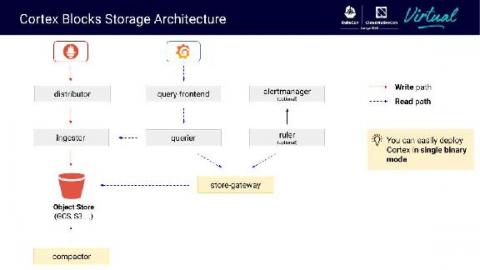
Yesterday at KubeCon + CloudNativeCon EU, Grafana Labs software engineer Marco Pracucci, a Cortex and Thanos maintainer, teamed up with Thor Hansen, a software engineer at Hashicorp, to give a presentation called “Scaling Prometheus: How we got some Thanos into Cortex.” In their talk, the pair discussed a new storage engine they have built into Cortex, how it can reduce the Cortex operational cost without compromising scalability and performance, and lessons learned from running Cortex at s