Operations | Monitoring | ITSM | DevOps | Cloud

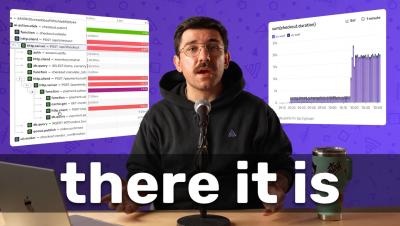
Eliminating Digital Friction with Nexthink Spark Episode 1: Fixing UI Slowness

Slow, unresponsive applications create digital friction that impacts employee productivity and generates unnecessary IT tickets. In Episode 1 of Eliminating Digital Friction with Nexthink Spark, see how Spark identifies UI slowness, pinpoints the root cause, and helps IT resolve issues faster.

Meet GCX: Give Your AI Coding Agent Production Context

Your AI agents are only as good as the context it has. Without access to what's happening in production, it can only make educated guesses. Chapters: In this video, you'll meet GCX. The bridge between AI coding agents like Claude Code, Codex, Cursor, and your Grafana observability stack. You will learn how GCX securely gives AI agents access to metrics, logs, traces, dashboards, and other production telemetry so they can investigate issues, answer questions, and help you debug with real operational context.

Golden paths: how to ship securely without slowing developers

The secure path and the easy path should be the same path. Ralph McTeggart (Principal Engineer), Alex Franzmann (Customer Onboarding Team Lead), and Claire McDyre (Product Manager) at Cloudsmith lay out how platform teams can deliver supply chain security as a capability rather than a checklist. The argument runs from first principles: make a private registry the default, automate policy enforcement at the global level, and extend that same logic to compliance – so SBOM generation happens in the pipeline, not as a developer's manual task.

Install AURA to Debug Incidents Using an Open Source SRE Agent

AURA is a fully open-source agentic harness built for SRE and production operations work. In this walkthrough, Mezmo forward deployed engineer Jeff iinstalls AURA on a local desktop, runs `aura init` to generate the config and connect it to an Anthropic Sonnet model, then wires in a Grafana MCP server pointed at his homelab. He hands AURA a live incident: a set of addressable LED lights that stopped responding to Home Assistant.

Supply chain hit: the first hours are about "am I affected?"

The first two to three hours after a supply chain compromise aren't about remediation – they're about figuring out whether you're affected at all. That requires two things: a feed of compromised packages you can cross-reference against what you're using, and an audit trail showing which developers pulled which packages and when. Teams that can answer "are we affected?" in 30 minutes have that data pre-built into their platform. Teams that don't are still piecing it together at hour three. Protect your supply chain with Cloudsmith.