Operations | Monitoring | ITSM | DevOps | Cloud

Asset & Inventory Tracking App: One Solution for All Industries

These days competition is so high everyone wants to utilize technology to its full potential which is why a mobile application for business is essential. Every businessman knows that nowadays every adult owns a smartphone. That is why almost all businesses have their own mobile application. However, for asset management, organizations utilize traditional asset tracking methods. As a result, lots of errors occur in data and work delays occur because no proper planning is done.


What Is Replatforming? Everything You Need To Know

Depending on your business reason for migrating to the cloud, you can either move in one go or incrementally. If, however, you prefer to retain some of your operations, app design, or workflows on-premise, you can still do so based on the cloud migration strategies you use. Sometimes, it makes more sense to modify your existing system rather than make too many changes all at once. Cost, data security, and service availability (thus revenue and customer experiences being impacted) are just three concerns.

COBIT Framework: A Different Take on Service Management

COBIT is one of the most widely used frameworks for IT governance. Among ITSM frameworks, COBIT is best known for aligning IT strategy with the overall business goals of the organization. Initially released in 1996, the framework has become popular among organizations for managing their IT risks, ensuring compliance, and keeping ITSM on track for achieving organizational goals. With this article, we hope to introduce you to the COBIT framework.

How One Company's IT Service Desk Used Automation to Reduce Incident Tickets

How a Northern-European car manufacturer dramatically reduced incoming tickets related to low disk space using 4 key automations. Incident tickets are an unavoidable, routine aspect of working in IT. But failing to identify and solve the root cause of the issue behind repeated tickets will cause unresolved tickets to pile up, creating a huge disruption for IT and employees.

CFEngine 3.20 released - Modularity

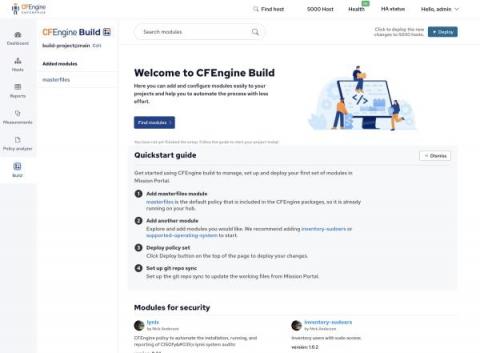
Today, we are pleased to announce the release of CFEngine 3.20.0! Over the past few years we’ve focused on ease of use, new user experience, and out of the box value, giving you the ability to do much more through only the Mission Portal Web UI. This has resulted in several important steps forward; policy analyzer, compliance reports, host specific data (CMDB), and CFEngine Build with custom promise types and other modules.

Build and deploy a Nuxt3 application to Netlify

Imagine you want to build and deploy a Nuxt3 app on Netlify. Because custom scripts are not allowed on Netlify, you will not be able to perform custom tasks like automated testing before deploying the website to your Jamstack hosting platform. That is where continuous integration/continuous deployment comes in. With a CI/CD system, you can run the kind of automated tests that create successful deployments.

DevOps Release Management Best Practices

Because DevOps practices can bring great speed and reliability to the software delivery lifecycle, release management can seem daunting. But, the improved visibility and collaboration brought about by DevOps can also help with the release management process. DevOps-centric release management is the future of software development and IT operations.

NoOps Explained: How Does NoOps Compare with DevOps?

Since the evolution of the IT industry, different concepts have been introduced to enhance and speed application production. Automating processes is gradually becoming the way forward and, so far, the best way to speed the deployment process of projects. Today, though, NoOps has come along. The prevalence of NoOps means manual intervention may not be needed in IT operations, but is this going to mean the extinction of DevOps? Turns out, NoOps might just be a next step in the progression of DevOps.