Operations | Monitoring | ITSM | DevOps | Cloud

ManageEngine recognized for unified endpoint management at RSA Conference 2020

In 2019, Cyber Defense Magazine named ManageEngine a Next Gen vendor in Unified Endpoint Management at IP EXPO in London, and then again at RSA Conference 2020 in San Francisco. Cyber Defense Magazine recognized ManageEngine in its 2020 InfoSec Awards for the features, capabilities, and value it delivers, along with its market presence.


New Ways to Uncover Trends with Discover

While powerful, our first iteration of Discover had some user experience complexities that made it less user-friendly than other potential search mechanisms. We also heard from you that our Events feature was useful for identifying individual events, but finding common patterns within those events was extremely difficult — keyword, ”was”. I want to share some of the features and the top 5 use cases that you can do with the refreshed Discover.

Elixir Package 1.12: Phoenix 1.5 Support & Better Channel Error Handling

Great news for all the Elixir alchemists, we’ve just released AppSignal for Elixir package version 1.12.0 which adds support for the upcoming 1.5 version of the Phoenix framework, and improves in-channel error handling. If you’re not an AppSignal user yet, make sure to check out the product tour and see how errors, performance, host metrics and triggers all come together in one tool. Phoenix 1.5 isn’t here yet, but AppSignal 1.12 is ready for it.

Kubernetes on AWS: EKS vs Kops

There are three popular methods for running Kubernetes on AWS: manually set up everything on EC2 instances, use Kops to manage your cluster, or use Amazon EKS to manage your cluster. Managing a Kubernetes cluster on AWS without any tooling is a complicated process that is not recommended for most administrators, so we will focus on using EKS or Kops. In this blog post, we compare cluster setup, management, and security features for both Kops and EKS to determine which solution you should use.

Web Application Testing: A 6-Step Guide

Almost every business today runs online. The internet is one of the easiest avenues for businesses to reach users, and websites are a great way to impress your customers. So, when you’re building a web application for your business, it’s important that you make it the best version it can be. To make sure that your web application is good enough to impress customers and avoid any negative impact, you have to test your application and fix any issues.

SquaredUp for Azure version 4.5

We are excited to announce the release of new versions of our two flagship products: SquaredUp for Azure version 4.5 and SquaredUp for SCOM version 4.5. Our product engineering teams have been working hard on the first big update since the launch of SquaredUp for Azure in November 2019, and have added some great new features and improvements based on customer feedback, including these beautiful cost visualizations…

New in Grafana 6.6: Forcing minimum alert evaluation frequency

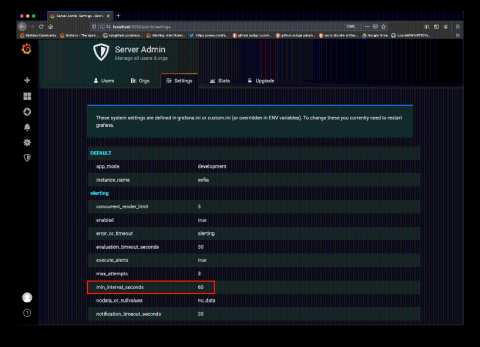
There has long been a request from administrators to have the ability to enforce a minimum interval between alert rule evaluations. This is useful for restricting unrealistic user-defined alert rules that evaluate too often and create unnecessary load in the backend. @Uepoch took the initiative and made all the necessary modifications for this configuration in Grafana’s backend, and we finally pushed it forward and introduced the feature in Grafana v6.6.

Optimizing a Golang service to reduce over 40% CPU

10 years ago, Google was facing a critical bottleneck caused by extremely prolonged C++ compilation times and needed a totally new way to solve it. Google engineers tackled the challenge by creating a new language called Go (aka Golang). The new language of Go borrows the best parts of C++, (most notably it’s performance and security features) and combines it with the speed of Python to enable Go to quickly use multiple cores while being able to implement concurrency.

How much does a status page cost?

Keeping your customers informed of the status of your website, application, or service is essential nowadays. If you don’t have a status page to communicate this, you’re missing an opportunity to improve transparency and reduce customer support burden. This is especially true if you are running an online business and your website is your main source of income, a status page is crucial not only for your business but for your customers as well.