Operations | Monitoring | ITSM | DevOps | Cloud

Metrics Monitoring: Choosing the right KPIs

Software metrics measure a software’s characteristics in a countable manner. That is why tracking the metrics is a huge part of the development stage. The goal of system metrics monitoring is to determine the quality of the product or process during the development and deployment stages. However, not all metrics are beneficial to your software development. That is why you need key performance indicators (KPI) that will help your processes to move forward.

New Metrics for IT Operations: Part 1

This blog is the first in a two-part series and was adapted from The Enterprisers Project. In 2020, a year like no other, is it still useful to measure IT value based on green, yellow, or red lights on a screen? Now that infrastructure is everything – powering productivity, cutting OPEX, and supporting digital initiatives that may change overnight – flashing lights on a monitor are no longer enough to keep the wheels moving.

Correlating Pingdom Alerts With AppOptics and Loggly in DigitalOcean Kubernetes

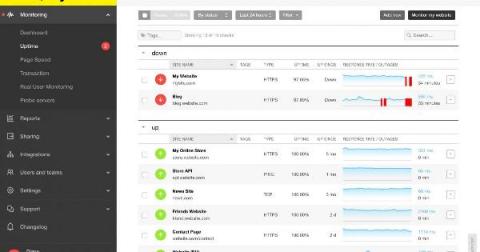
So SolarWinds® Pingdom® has alerted you to an issue—what do you do now? In this article, I’ll explain the features and capabilities of a full monitoring stack in SolarWinds and how you can use it to get to the bottom of a 3 a.m. Pingdom wake-up call. The Setup For our web service, we use a simple architecture of a front-end Flask application with a Postgres back end served behind an edge SSL-terminating NGINX instance on the DigitalOcean Managed Kubernetes service.

Walking Through a Call From Pingdom Alert to DigitalOcean Managed Kubernetes

SolarWinds® Pingdom® is an external synthetic monitoring agent designed to monitor your systems from the outside in. If you know what clues to look for, it can provide a great place to triage where a problem is occurring in the system. So how does a Pingdom call work, and how can you use it to debug what’s happening inside the system?

Cloud Profiler provides app performance insights, without the overhead

Do you have an application that’s a little… sluggish? Cloud Profiler, Google Cloud’s continuous application profiling tool, can quickly find poor performing code that slows your app performance and drives up your compute bill. In fact, by helping you find the source of memory leaks and other errors, Profiler has helped some of Google Cloud’s largest accounts reduce their CPU consumption by double-digit percentage points.

NEW Feature: Configurable Assurance Alerts

At RapidSpike everyone gets involved with product and feature ideation, including our customers! We pride ourselves on being responsive to your needs, taking your feedback, and turning it into our next great feature — after all, you know what you need. We’re here to listen and our developers love tackling a new challenge and solving a tricky problem. This has trickled down into one of our latest features — Configurable Assurance Alerts.

Monitor your NVIDIA Jetson IoT devices with Datadog

NVIDIA Jetson is a family of embedded, low-power computing boards designed to support machine learning and AI applications at the edge. Organizations use Jetson boards for complex video and image processing and analysis, automating build processes in factories, and improving city infrastructures. For example, Jetson-based devices enable cities to analyze traffic patterns with their existing traffic cameras in order to find ways to improve their most congested intersections.

Datadog automatically surfaces actionable insights into your Lambda functions

Serverless platforms like AWS Lambda have helped accelerate application development by removing the need to provision and manage infrastructure resources. However, serverless architecture presents new monitoring challenges. Because AWS Lambda handles underlying infrastructure for you, you don’t have access to system-level metrics. Instead, you have to monitor your Lambda functions for insight into their performance and resource usage.