Operations | Monitoring | ITSM | DevOps | Cloud

Q&A from the Moogsoft/Datadog Fireside Chat

On April 15th Moogsoft’s VP Marketing, John Haley, welcomed Datadog Product Manager, Alex Vetras, along with DevOps Institute Chief Ambassador, Helen Beal, and Moogsoft’s CTO, Dave Casper, for an informal roundtable exploring how users can now see rich-context incidents from across the full stack in minutes, and the opportunities this presents to organizations.


6 Steps to Getting Started With Observability

During my office hours, I frequently get asked for practical tips on getting started with observability. Often it’s from folks on teams who are already practicing continuous delivery (or trying to get there) and are interested in more advanced practices like progressive delivery. They know observability can help—but as individual contributors—they don’t sign the checks, so they feel powerless to help get their team started with observability.

How To - Monitor Split Tunnel Traffic with Catchpoint

When the world transitioned to a remote workspace, one of the things that most of us figured out quickly was that some applications just don’t work well with corporate VPN. Video and voice applications, like Microsoft Teams, are essential to business operations. I wouldn’t want to add another point of failure that I’d need to troubleshoot if I didn’t have to.

The IT Skills Gap-A Downside of Innovation

Innovation is widely accepted to be a great thing—think of all the new products, technologies, methodologies, services, etc. unveiled at any given time. At this point, you’re probably thinking, "This all sounds great! Why would someone be writing about a downside of innovation?" Innovation is great when it pushes the boundaries of what can be achieved and inspires people to build upon things others have built or dreamed of. But innovation is useless without adoption.

Logz.io and the AWS Distro for OpenTelemetry

Amazon Web Services has announced enhanced support for the open-source distribution of the OpenTelemetry project for its users. AWS Distro for OpenTelemetry (ADOT) now includes support for AWS Lambda layers for the most popular languages and additional partners integrated into the ADOT collector. And one of those partners is Logz.io! Logz.io is happy to announce that our exporter is now included in the AWS Distro for OpenTelemetry.

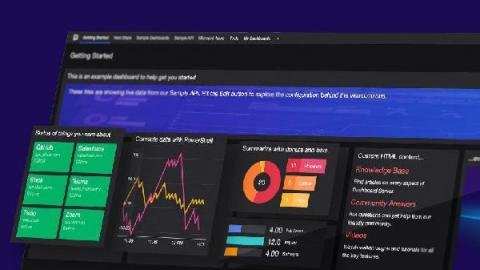
Dashboard Server: Working with the SQL tile

In my previous blogs in the Dashboard Server Learning Path, we looked at working with the Web API tile and the PowerShell tile. In this instalment, let’s try the SQL tile. This tile will let you connect to any SQL database and run a SQL query straight from SquaredUp. This tile is also available in both the SquaredUp for SCOM and Azure products, so I have some familiarity with it already.

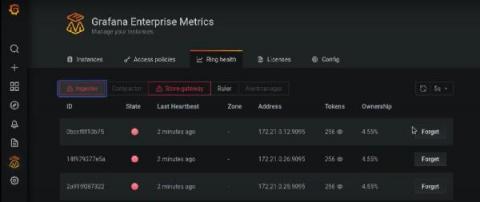
What's new in Grafana Enterprise Metrics 1.3, our scalable, self-hosted Prometheus service

We built Grafana Enterprise Metrics (GEM) to empower centralized observability teams to provide a multi-tenanted, horizontally scalable Prometheus-as-a-Service experience for their end users. The GEM plugin for Grafana is a key piece of realizing this vision. It provides a point-and-click way for teams operating GEM to understand the state of their cluster and manage settings for each of the tenants within it.

How to monitor Microsoft SQL Server with Prometheus

In this article, you will learn how to monitor SQL Server with Prometheus. SQL Server is a popular database, which is very straightforward to monitor with a simple Prometheus exporter. Like all databases, SQL Server has many points of failure, such as delays in transactions or too many connections in the database. We are basing this guide on Golden Signals, a reduced set of metrics that offer a wide view of a service from a user or consumer perspective.

Key Kubernetes Metrics and Resources to Monitor for Peak Cluster Performance

Monitoring is not easy. Period. In our guide to Kubernetes monitoring we explained how you need a different approach to monitoring Kubernetes than with traditional VMs. In this blog post, we’ll go into more detail about the key Kubernetes metrics you have access to and how to make sense of them. Kubernetes is the most popular container orchestrator currently available. It’s available as a service across all major cloud providers. Kubernetes is now a household name.