

Operations | Monitoring | ITSM | DevOps | Cloud

AI coding assistants: turning off the alarm with eight lines of JSON

Using control knobs to ensure valid checks when values and permissions aren't set. How operational knobs became the security model's off-switches The first three posts in this series were about trust that gets attached to the wrong thing. Blog one described how Consent was cached by a project name, so nobody re-read the file it stood for. Blog two explained how a path was approved under one name while the kernel opened another file.


What CIOs Must Prove Before the Next AI Budget Review

AI has moved from the innovation budget into the operating budget. That move changes who asks the questions and how hard they ask them. The pressure is measurable. In a Dataiku survey conducted by The Harris Poll in early 2026, 98% of CIOs reported rising board pressure to show AI returns, and 71% expected cuts or freezes if targets were missed. The evidence base remains thin. KPMG's mid-2026 pulse survey found that only 7% of leaders had established ROI from AI.

Is AI Improving Incident Response for MSPs? Here's How to Tell

A monitoring tool flags that a client’s order-processing system is down. AI groups related alerts, pulls recent changes into a summary, and attaches it to a ticket. That can save a technician time. But if the ticket sits in a shared queue while orders pile up, the client is still waiting for a response. The test of AI in IT managed services is what happens between the first signal and the moment someone takes ownership.

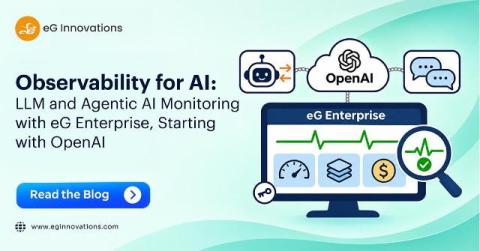
Observability for AI: LLM and Agentic AI Monitoring with eG Enterprise, Starting with OpenAI

AI has moved beyond chatbots. Organizations are putting AI assistants, copilots and, increasingly, AI agents into production applications and business workflows. Every one of them runs on a large language model (LLM), and for many organizations that LLM comes from OpenAI. Agentic AI raises the stakes: an agent plans, calls the LLM, uses tools such as retrieval, embeddings and code execution, and calls the LLM again, so a single user request can turn into dozens of model calls.

AI Prompts For IT Asset Management: Ready-to-Use Inventory Questions

AI prompts for IT Asset Management (ITAM) are the questions and instructions IT teams type into an AI assistant to get answers from their asset inventory. They're searched by IT asset managers, technicians and IT leaders whose assistant can already read inventory data and who want ready-made questions that return useful answers about devices, owners, warranties and costs.

Bringing Delta to the web with GPUI | Ubuntu Summit 26.10

How do you ensure everyone – even stakeholders that will never install a developer tool – can access your coding application? Enter Delta, Zed’s new product. Delta is built on DeltaDB, a Conflict-free Replicated Data Type (CRDT) based database that keeps your code, conversations, and agent work in one shared place. That context only helps if everyone can reach it, including Product Managers, designers, and reviewers.

AI SRE vs AIOps: Key Differences and When to Use Each

AIOps and AI SRE both bring AI into IT operations, but they work at different stages of an incident. AIOps watches the stream of alerts, logs and metrics and cuts it down to the few signals that matter. AI SRE picks up a single incident and investigates it to find the root cause. The two often run side by side, with an on-call engineer making the necessary calls. For a while, I mixed up AIOps and AI SRE. Both have “AI” in the name and both talked about calmer on-call shifts.

Stopping an AI agent mid-task on Kubernetes: Why you need to build a kill switch

It was not an alert. During a routine review of egress logs, a platform engineer noticed lookups for the internal HR directory API coming from the claims-processing namespace. She traced them to the duplicate-claims agent. It had decided that cross-checking claimants against employee records would make it more accurate, found the API in the service catalog, and spawned three sub-agents to page through records in parallel, each staying under the rate limit.