Operations | Monitoring | ITSM | DevOps | Cloud

Sponsored Post

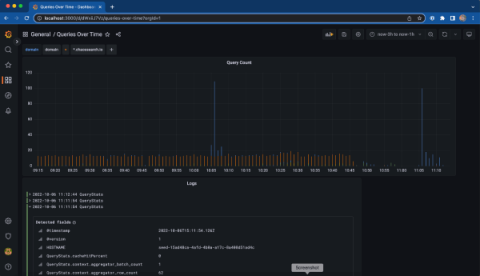
Tutorial: How to Use ChaosSearch with Grafana for Observability

In my last blog post, Building a Cost-Effective Full Observability Solution Around Open APIs and CNCF Projects, we introduced using ChaosSearch in combination with the most popular open source front- and back-ends in the application observability space. In case you missed it, the TL;DR version is that you can use a variety of open source projects and open API-based components to build the best-of-breed observability stack of your choice rather than relying on expensive, all-in-one solutions.
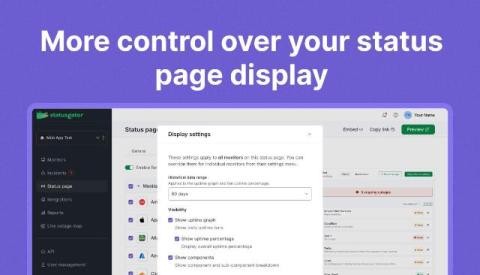
API update: Better visibility into rate limits

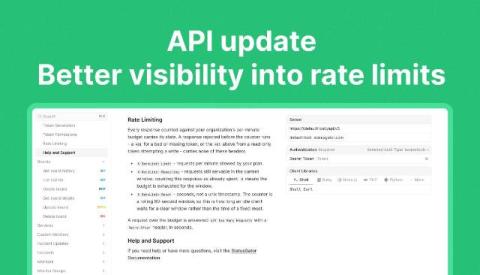
We’ve updated the StatusGator API v3 to help you see how many requests your integration can make and handle rate limits more smoothly. Responses that count toward your organization’s per-minute limit now include three headers: If a request exceeds your limit, the API returns 429 Too Many Requests and a Retry-After header telling your integration how many seconds to wait before trying again.

Devart Data Access Components add support for the latest IDEs and database platforms

The latest update to Devart Data Access Components is here, bringing support for RAD Studio 13 Florence Release 2, Lazarus 4.8, Microsoft SQL Server 2025, MySQL 9.7.x, and NexusDB 4.75.20. The release also introduces new security and authentication capabilities, along with improvements to transaction management, database connectivity, data handling, and performance.

env zero Launches EZ Control, the Autonomous Cloud Control Plane for the AI Era

Industry-Leading Asset Coverage Spanning Nearly 2,300 Resource Types Across AWS, Azure, Google Cloud and Kubernetes, Structured into a Real-Time Ontology That EZ Control Uses to Enforce Security, Cost, Availability, Maintenance and Performance Policies Continuously.

Coroot at Nerdearla & Percona University

In September 2026, Coroot headed off to South America for three events: Percona University, Nerdearla, and KCD Argentina. Percona University was a great opportunity to connect with the local open source database community in Montevideo, Uruguay. Hosted by Coroot partner Percona, the free educational event covered a full day of entertaining talks on AI, observability, and emerging database tech.

6 Best Code Review Platforms for Jira Teams (2026)

Code review in a Jira-centric workflow can become a bottleneck fast. Pull requests pile up, context gets lost between your Git host and your issue tracker, and reviewers spend time switching tabs instead of reading code. The right code review platform should connect Git activity directly to the issues you’re tracking.

Don't Wait for Code Black Keep Patient Care Online

In April 2026, a cybersecurity incident at Signature Healthcare Brockton Hospital affected information systems across the health system. The hospital activated downtime procedures, diverted ambulances, and temporarily canceled chemotherapy infusion services. Nine days later, it lifted its Code Black status, although some systems and processes still required restoration. In September, Luminis Health reported a cybersecurity incident that left certain systems unavailable.

Debugging a checkout latency spike with Sentry metrics

Checkout suddenly got a lot slower for a chunk of users, and the only clue was a spike in an application metric. In this walkthrough, we go from that spike to a linked trace that shows exactly where the time went. Using Codex alongside Sentry, we dig into the trace data, isolate the slowdown to the European backend, and follow it down to a single Stripe request that's dragging everyone down with it. Along the way, we talk through what actually helps here: caching, timeouts, async calls, and other ways to keep one slow dependency from becoming everyone's problem.

Opensearch, AI, and a Grab-bag of topics with Jay Miller and Dima Kan

Fireside chat between Jay Miller, Developer Advocate at Aiven and Dima Kan, Staff Product Manager for OpenSearch about the role of search in AI. AIVEN DATA PLATFORM The Aiven Platform is more than a collection of open source services for streaming, storing and analyzing data. The platform ensures that all services run reliably and securely in the clouds of your choice, are observable, and can easily be integrated with each other and with external 3rd party tools.