Mailchimp
Not subscribed to OpsMatters Newsletter


So far in this series, I’ve outlined how a scaling enterprise’s accumulation of data (data gravity) struggles against three consistent forces: cost, performance, and reliability. This struggle changes an enterprise; this is “digital transformation,” affecting everything from how business domains are represented in IT to software architectures, development and deployment models, and even personnel structures.
Google Cloud provides its own set of metrics for monitoring applications, services, and instances. There are a huge number of metrics – more than 1,500 different ones just for GCP monitoring! While this is great, dealing with such a number can also be overwhelming. Filtering, pulling, exploring, and storing the metrics that you really need can be an enormously time-consuming task, and a big challenge.
In this post we want to give a simple introduction for using network policies in a sample project and explaining how it works in K3s to help improving the security of your deployments. There is a common misunderstanding about K3s support for network policies, as K3s is using flannel CNI by default, and the Flannel CNI doesn’t support network polices.
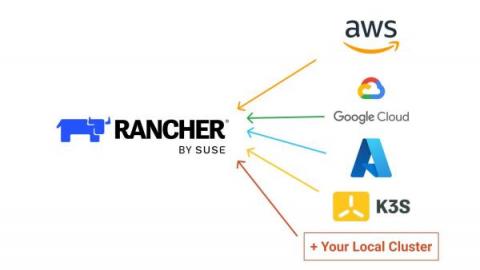
Rancher is a Kubernetes management platform that creates a consistent environment for multicloud container operation. It solves several of the challenges around multicloud Kubernetes deployments, such as poor visibility into where workloads are running and the lack of centralized authentication and access control. Multicloud improves resiliency by letting you distribute applications across providers.