Honeybadger Actions
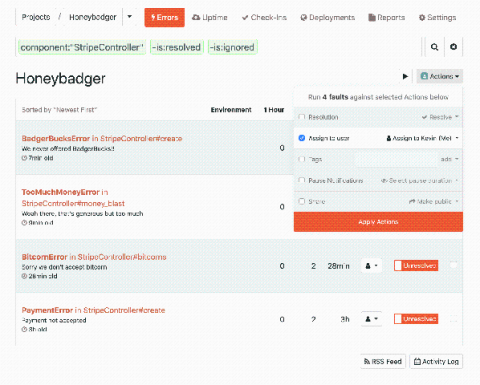
Have you ever wanted to update all your errors at once, or set defaults for incoming errors? Well, we are releasing some helpful tools for error management that we call Honeybadger Actions.


Have you ever wanted to update all your errors at once, or set defaults for incoming errors? Well, we are releasing some helpful tools for error management that we call Honeybadger Actions.
At LogicMonitor, we are continuously improving our platform with regards to performance and scalability. One of the key features of the LogicMonitor platform is the capability of post-processing the data returned by monitored systems using data not available in the raw output, i.e. complex datapoints. As complex datapoints are computed by LogicMonitor itself after raw data collection, it is one of the most computationally intensive parts of LogicMonitor’s metrics processing pipeline.
Many enterprises have already adopted Kubernetes or have a Kubernetes migration plan in place, making it clear that the platform is here to stay. While it provides a lot of benefits to its users, to take advantage of them, you need to thoroughly learn Kubernetes and how it works in production. Typically, the most difficult aspects of Kubernetes are learned through experience solving real-world problems.
Velocity, much like the pulse rate or oxygen level of an individual, is an important measure of health for your development team. A low velocity score for recent sprints limits your team's options for delivering value. Sustained failure to deliver to stakeholders can erode trust with those stakeholders quickly. But how do you know exactly what your velocity is and how you can improve it?