Operations | Monitoring | ITSM | DevOps | Cloud

The latest News and Information on Microsoft 365 and related technologies.

Microsoft Office 365 Update and Linux Security Enhancements

Microsoft extends rollback support for Office 365 updates to two months and discloses a vulnerability without zero-day exploits. SQL updates now require specific version and driver fixes. Ivanti releases three security updates addressing 11 CVEs, while a partnership with Tuck Care improves Linux patching. Misconceptions about Linux security are addressed, emphasizing the need for regular updates to mitigate risks from notable CVEs across distributions.

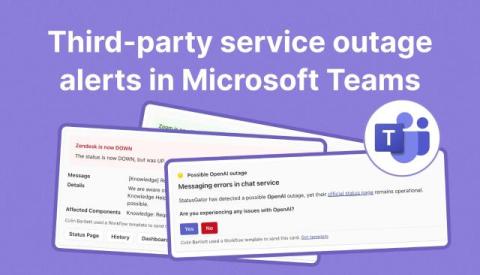
StatusGator now supports Microsoft Teams Workflows

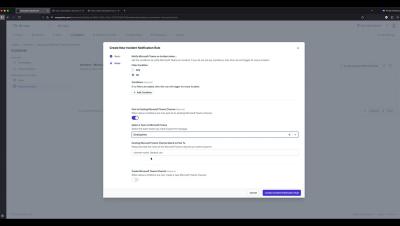
We’ve updated our Microsoft Teams integration to support workflows — Microsoft’s new and recommended approach to incoming webhooks. As Microsoft evolves its platform, it is phasing out the legacy Connectors feature in favor of Workflows. At StatusGator, we’re committed to keeping up with these changes so your integrations remain reliable and future-proof.

Beyond the Horizon: Unlocking the Real MSP Value in Microsoft 365

In this insightful episode, we dive deep into the real-world challenges and opportunities facing MSPs working with Microsoft 365 and related Microsoft technologies. N-able Head Nerd Joe Ferla is joined by Ben Lee, the latest to the Head Nerd team who is a seasoned Microsoft consultant with decades of experience in unified communications, Teams, Intune, and Microsoft Co-pilot. During the conversation Joe and Ben discuss the challenges MSPs and SMEs face when implement Microsoft’s powerful but often complex ecosystem.

Top 3 reporting tools for Microsoft Teams: SquaredUp, Power BI & M365 Admin Center

Microsoft Teams is a ubiquitous presence in workplaces all over the world. Prior to 2020, its usage was relatively moderate, with around 20 million users. However, global restrictions during the pandemic led to a 3,500% growth. Teams is now so central to business operations that Microsoft retired Skype in its favor. But this massive scale created a new problem – businesses needed better ways to monitor and report on their Teams usage.

Stop paying for Microsoft 365 licenses

When someone leaves your company, the natural step is to disable their Microsoft 365 account. But what many businesses don’t realize is that they often continue paying for that user’s license — just to retain access to their OneDrive files, Teams chats, and emails. Over time, this adds up to thousands in unnecessary costs. In this article, we’ll explain.

Departed M365 Users

When someone leaves your organization, the first step IT usually takes is to disable their Microsoft 365 account. But have you ever stopped to ask: The answer might surprise you. If you’re not actively managing this, Microsoft will automatically delete that data — often in as little as 30 days. This post explains exactly what gets deleted (and when), why this is a problem, and what you can do to protect that data — without paying for unnecessary licenses.

Top Microsoft Teams Metrics: How to Measure & Improve Call Quality

As an IT professional, you know that Microsoft Teams is only as good as the network it runs on. Poor call quality (choppy audio, frozen video, or sudden disconnections) can disrupt productivity and frustrate users. But how do you pinpoint the root cause? The answer lies in monitoring Microsoft Teams performance metrics.

Need a better tool for managing hybrid collaboration environments?

If your clients are like most, they use multiple collaboration platforms to drive business and get work done. A common combo is Microsoft Teams and Zoom: over 60% of organizations use both, and together the two have a more than 80% share of the videoconferencing market. More platforms mean more complexity for you to manage — more parameters to watch, more tools to bounce between to keep an eye on things.

Is hybrid collaboration causing you headaches?

Real-time collaboration and virtual meetings have become part of the basic fabric of how work gets done. Because different collaboration platforms do different things really well, most organizations tend to mix and match them to fit their requirements. Teams and Zoom are two of the most common pairings. A study commissioned by Zoom and conducted by the research firm, Metrigy found that 62% of companies use both.