What Is a DNS Prefetch?
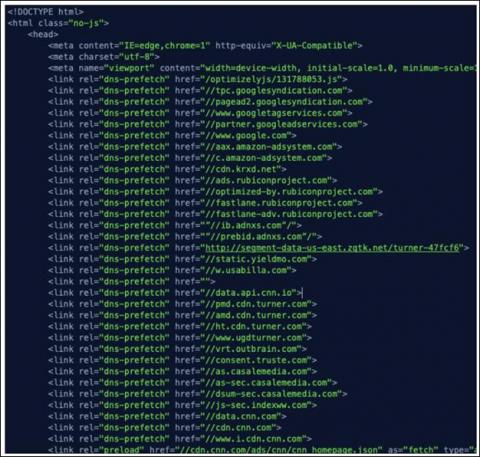
This article helps you understand DNS prefetching, one type of resource hint, including what they are, why and how to use them, and best practices for auditing and scaling them.


The latest News and Information on Log Management, Log Analytics and related technologies.
This article helps you understand DNS prefetching, one type of resource hint, including what they are, why and how to use them, and best practices for auditing and scaling them.
In this article, let’s take a look at preconnect resource hints — what they are, why and how to use them, and best practices for auditing and scaling them.
Since the beginning of the Internet, the speed of delivering content has been an issue. While processor enhancements, network acceleration, and web frameworks have brought drastic improvements to performance, the goalposts have continued to shift further away; devices operate on wireless connections with limited bandwidth, and the Internet is accessed from every corner of the globe.
On May 27, 2022, an interesting Microsoft Word doc was uploaded to VirusTotal by an independent security research team called nao_sec. The Word doc contains built-in code that calls an HTML file from a remote source that in-turn executes more (malicious) code and Microsoft Defender for Endpoint misses detection. Two days later, May 29, Kevin Beaumont publishes an article describing the behavior of this Word doc, and deems this a new 0-day vulnerability in Office/Windows products.
If there was a question on if an enterprise needed an observability pipeline in 2019 or 2020, we now know the answer is: yes. The observability data management methods of the 2010s aren’t going to work in the 2020s. Data is growing too fast for us to ignore, and the need to gain intelligence from said data continues to grow in importance. Data (and access to it) is becoming a competitive edge for many enterprises today.
From the moment Elastic announced plans to abandon a pure open source license for its Elasticsearch engine and Kibana dashboards in early 2021, there’s been a massive effort underway to create clear alternatives for the global community of active users. Logz.io has been an outspoken advocate and contributor to this work – fully embracing it as part of our product roadmap to best serve the needs of our customers, and preserve our long-term commitment to open source observability.
An old colleague of mine once said to me, “It doesn’t matter how inefficiently something DOESN’T work.” This was a joke used to make a point, so it stuck with me. It also made me consider that it does matter how efficiently something DOES work. Sometimes, when we have tools like Cribl Stream making things like routing, reducing, and transforming data so easy, we can forget that there might be a more efficient way to do it.
With the rise of microservices and distributed systems, more and more data migrates through APIs. So, let’s look at the best ways to monitoring APIs using authentication.
APIs have existed nearly as long as websites themselves. But because APIs are primarily consumed by programs instead of people, they tend to be less visible than applications or sites directly accessed by users. The result: APIs often receive far less attention from a site reliability engineering (SRE) and monitoring perspective than other parts of application environments.
The cost of cybercrime is predicted to hit $10.5 trillion by 2025, according to the latest version of the Cisco/Cybersecurity Ventures "2022 Cybersecurity Almanac." The way that people work, the tools that they use, and the mindset they must adopt to protect the enterprise has to evolve to keep up with the threat landscape.