Operations | Monitoring | ITSM | DevOps | Cloud

Better Than 'Business As Usual': Rethinking How PagerDuty Works in a Post-COVID-19 World

Earlier this year, as COVID-19 appeared, our global community of almost 800 employees became a fully remote workforce—effectively overnight. Now, all of us have had a taste of what it’s like to work from home all the time, from embracing the benefits of less time commuting and more time with our families, to the downsides of feeling isolated and missing seeing our colleagues in “real life.”


How to set up OpenID Connect on Elastic Cloud with Azure, Google, or Okta

OpenID Connect (OIDC) is an authentication layer based on OAuth 2.0 protocol that provides a way to identify and authenticate users via an authorization server. OAuth 2.0 authorization servers are managed by identity providers. In the domain associated with OIDC, they are also called OpenID Connect Providers (OPs). OIDC allows users to connect to web applications in a simplistic single sign-on (SSO) manner thanks to the identity provider.

Elastic Workplace Search and Gmail: Unified search across all your content

As work from home has ballooned in 2020, virtual methods for communicating with colleagues have become more critical than ever. Same goes for all the useful productivity and collaboration tools at our disposal. The emerging downside is the difficulty of finding needed information among so many tools. Compounding the problem is the tendency for info to get siloed off by department.

Using Observability to Inspect and Adapt CI/CD Pipelines

In this blog post series, I’ve explored the relationship between observability and a set of software delivery lifecycle practices that help organizations adopt DevOps practices and change their ways of working from being project centric to product-centric. I started with Site Reliability Engineering, then considered Value Stream Management (VSM) and finish with this post on Continuous Integration and Delivery (CI/CD). Defining Continuous Integration

Exploring AWS Lambda Deployment Limits

We have explored how we can deploy Machine Learning models using AWS Lambda. Deploying ML models with AWS Lambda is suitable for early-stage projects as there are certain limitations in using Lambda function. However, this is not a reason to worry if you need to utilize AWS Lambda to its full potential for your Machine Learning project. When working with Lambda functions its a constant worry about the size of deployment packages for a developer.

Markley Group Gains Better Visibility, Automation with OpsRamp

Markley Group is a Boston-based data center leader that provides co-location and private cloud services through a three-million square foot data center portfolio. The company was founded in 1991, when there was no such thing as the cloud. Today, many of its customers are experimenting in public cloud but often have workload requirements which are better suited or more affordable running on private infrastructure, according to Patrick Houston, Director of Engineering at Markley Group.

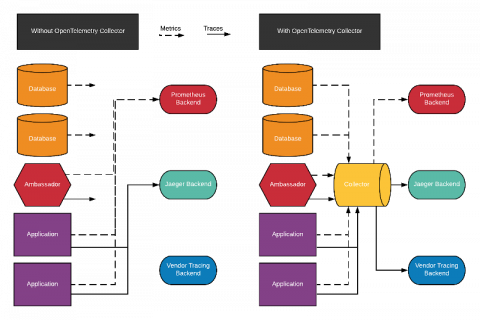
Configuring the OpenTelemetry Collector

The OpenTelemetry Collector is a new, vendor-agnostic agent that can receive and send metrics and traces of many formats. It is a powerful tool in a cloud-native observability stack, especially when you have apps using multiple distributed tracing formats, like Zipkin and Jaeger; or, you want to send data to multiple backends like an in-house solution and a vendor. This article will walk you through configuring and deploying the OpenTelemetry Collector for such scenarios.

Thales accelerates incident resolution & decreases downtime with Exigence

Thales Cloud Protection & Licensing, part of the Thales Group, was looking to improve how it handles critical incidents. Whenever an incident hit just gathering up the incident team would be a cumbersome and time-consuming task that involved a lot of manual work . Multiple calendar invites would be sent to different people in and outside of the organization, multiple times, urging them to join calls and meetings.

Planning Your Log Collection

Whether you are planning to use Graylog for security and threat hunting, IT Operations analysis and reporting, or any other use case, getting your logs into Graylog is essential. The process of log collection is sometimes a daunting task, especially if you are planning to collect massive amounts of data. But if you take a minute to answer some key questions before you begin, you can transform the log collection task from daunting to smooth sailing. Here we go with the questions...