Operations | Monitoring | ITSM | DevOps | Cloud

A Year of WebPageTest and Catchpoint: A Q&A with Tim Kadlec and Jeena James

Look out for our other video Q&As this week with Catchpoint co-founders, Mehdi Daoudi, CEO and Dritan Suljoti, Chief Product and Technology Officer. ‍Jeena: Can you tell us what you've been up to, what you've been doing with the team for the last couple of months, and how's it been so far with Catchpoint and WebPageTest?


Replay Log in Distributed Icinga Environments

An essential part of a distributed monitoring environment with Icinga that includes master, satellite and agent nodes is the replay log functionality. The replay log is a built-in mechanism to ensure nodes in a distributed setup keep the same history e.g. check results, notifications and downtimes if nodes are temporarily disconnected and then reconnect.

Agile User Stories: Examples and Templates

Creating a new product or implementing a new feature should be rewarding and encourage innovation. However, when a development team is instead stuck writing lengthy requirements documentation with suffocatingly rigid guidelines, that may not always be the case. Traditional software development methods relied heavily on following a predetermined set of requirements for each unique feature of a given product, service, or application.

Tutorial: Getting Started with AWS Lambda and Node.js

AWS Lambda is an incredible tool that works well with an abundance of other services on AWS. In this hands-on walkthrough, we’ll show you how to get started and create your first Node.js AWS Lambda function. Once upon a time, not so long ago, a word caught my ear. Lambda. That struck a chord, remembering the good old days of playing Half-Life as a kid. Little did I know what AWS Lambda was and how incredibly awesome it is. If you’re intrigued, stick around.

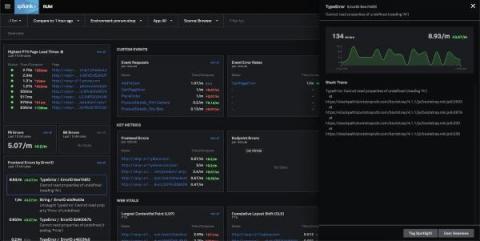
Splunk RUM Frontend Error Monitoring is Now Generally Available!

Debugging errors is an essential component to SRE and developer workflows. “How do we prioritize and isolate JavaScript errors more effectively?” is a top challenge we hear from engineering teams looking to improve end-user experience. Therefore, we are excited to announce the general availability of Splunk RUM frontend error monitoring.

Five Critical Insights You Won't Get With Your Cloud Provider's Monitoring Solution Alone

When meeting with a current or prospective Splunk customer, one question we are often asked is “Why do I need Splunk when I can just use AWS Cloudwatch, Azure Monitor, or GCP Cloud Operations Suite (formerly known as Stackdriver) for my cloud monitoring needs?” And what a great question it is!

AI Search: The secret to better customer self-service

Hari Vats, senior knowledge manager of global technical support at ServiceNow, co-authored this blog. Who wouldn’t want a faster, more relevant search on their knowledge base? Improving search results is tricky. Organizations can spend a lot of time and money making small improvements to very complex, dynamic environments of information. When ServiceNow acquired an AI search technology company in 2020, we were thrilled to see an immediate return.

Hello? Why Your IT Service Desk Won't Be There Tomorrow

(This article originally appeared in IT Pro Portal) The service desk as we know it isn’t going to vanish into thin air. But, there are some clear indications that the concept of the service desk as we know it is already evolving into something else, something more innovative. The old way of responding to tickets and problem-solving in silos is over.

Canonical Kubernetes 1.23 hits GA

The Kubernetes crew at Canonical is delighted to announce that Canonical Kubernetes 1.23 is now generally available. The team is committed to releasing in tandem with upstream so our users and customers can benefit from the latest features and improvements as soon as they become available. This blog is a quick introduction to Canonical Kubernetes and the top features available in release 1.23.

How we designed Ubuntu Pro for Confidential Computing on Azure

Not all data is destined to be public. Moving workloads that handle secret or private data from an on-premise setup to a public cloud introduces a new attack surface with different risks. As the public cloud environment shares its hardware infrastructure, a flaw in the clouds’ isolation mechanisms can be detrimental to the protection of sensitive data. The major public cloud environments tackle this by building their security following a defense-in-depth approach.