Operations | Monitoring | ITSM | DevOps | Cloud

Proactive Insights: How to Go from Reacting to Preventing Network Issues

If you’re an IT or network operations leader, consider the following questions: Network operators know how frustrating it can be to constantly contend with pressing network issues and outages. These team members spend copious amounts of time putting out fires, rather than focusing on efforts like making plans to optimize the network. These teams have to deal with high volumes of false alarms as well real incidents that affect network performance and availability and the user experience.
Enhancing IT Operations: Exploring End-to-End Observability

Organizations like yours are increasingly reliant on complex IT infrastructures to support their operations. Pervasive use of Kubernetes and microservices architectures continues to up the ante. Amidst this complexity, achieving comprehensive visibility into systems and applications has become both imperative for ensuring performance, reliability, and security, while also becoming ever-more challenging to achieve.

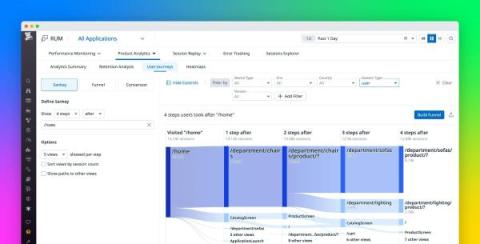
Analyze multiple user journeys with the Datadog Sankey visualization

Funnels can be powerful tools for analyzing your UX, but figuring out exactly which user journeys you want to study can be challenging. Even if you have an ideal journey in mind, users often take steps you don’t expect. As a result, your funnels—and therefore, your optimization efforts—can easily miss the most influential pages in your application. Indeed, how do you build the best possible funnel when there are thousands of paths users can take after any given page?

Integration roundup: Monitoring your container-native technologies

Container-native technologies increase the scalability and speed of deployment offered by containerized infrastructure, but they also present new monitoring challenges for organizations that adopt them. For example, because containers are ephemeral and share resources, tracking resource provisioning in container-native tools is essential to ensure consistent application performance.

System Hardening: Why the Need to Strengthen System Cybersecurity

Today, digital trust is required inside and outside the organization, so tools must be implemented, with cybersecurity methods and best practices in each layer of your systems and their infrastructure: applications, operating systems, users, both on-premise and in the cloud. This is what we call System Hardening an essential practice that lays the foundation for a safe IT infrastructure.

New Release: Integrated GenAI, Enhanced Monitoring, and More

Selector is excited to give a sneak peek into new features to be included in our forthcoming Spring Release. This release highlights key innovations focusing on integrated generative AI (GenAI) to enable guided troubleshooting and automated incident remediation. It also includes enhancements to several existing features, such as root cause analysis, native monitoring, and observability capabilities.

Application Troubleshooting with Automated Root Cause Analysis

In the complex and fast-paced world of application deployment, getting a handle on the tangle of services and resources can sometimes feel like trying to find your way through a maze without a map. And if something goes wrong, trying to find out what's happening where is even more difficult. With alert emails flooding in and questions flying left and right, identifying the glitch that's causing issues can seem like a Herculean feat.

Easy Guide to Monitor Jenkins Jobs Using Telegraf and MetricFire

Monitoring Jenkins jobs and nodes is foundational to maintaining a robust, efficient, and secure CI/CD pipeline. It enables DevOps teams to stay proactive about system health, optimize performance, manage resources effectively, and adhere to security and compliance standards. In this article, we'll detail how to use the Telegraf agent to collect performance metrics from your Jenkins environment, and forward them to a datasource.

What is INP and why you should care

On March 12th 2024, Google is launching a new Core Web Vital metric, Interaction to Next Paint (INP). INP will replace First Input Delay (FID) and will change the way your sites are assessed for performance by Google, which ultimately affects how your sites rank in search engine results. TL;DR: You need to start optimizing for INP today so your sites are not negatively impacted after March 12th.

Evidence-Based Threat Detection With Corelight and Cribl

Organizations today face a growing list of obstacles as they try to improve their detection, coverage, and accuracy. For one, data proliferation is happening at an astronomical rate. When was the last time your network bandwidth went down? What about your license costs for data storage or your SIEM? Difficulties arise from overlapping and poorly integrated tools that generate disparate data streams and several operational efficiencies.