Operations | Monitoring | ITSM | DevOps | Cloud

One Reason Why Your Nodes' Memory Usage Is Running High

When you’re using Cribl Stream and Cribl Edge to send data to hundreds of Splunk indexers using Load Balancing-enabed Destinations, it is sometimes necessary to analyze memory usage. In this blog post, we delve into buffer management, memory usage calculations, and mitigation strategies to help you optimize your configuration and avoid memory issues.


Three Ways to Assure Network Quality

What is the quality of your network? More to the point, what is the quality of the network experience? Do your employees think that your network is slow? Merely adequate? Speedy? At the highest level, this is what network operations teams need to understand how to answer. And this needs to be answered no matter how complicated the network path is between endpoints. We’ll take a look at three things that can help you get a handle on these questions.

What you're currently missing from your CDN monitoring tool

Content Delivery Networks (CDN) have been an inherent part of modern software infrastructure for years. They allow for faster and more reliable web-content delivery to users regardless of their location and an additional level of protection against DDoS Attacks and server failure. But just like any infrastructure service, they still fail from time to time and have their quirks. Enter CDN monitoring tools, providing insights on the performance of your CDN and helping troubleshoot issues.

Optimize Azure spending with Turbo360's periodic notifications

Is your Azure spend management getting out of control? You’re not alone. Countless businesses struggle with the exact problem, often lacking clarity on the reasons behind the cost spike. Especially within larger organizations, where multiple teams deploy Azure resources, the Azure costs can quickly get out of control without the necessary tools to effectively track the spending and evaluate monthly Azure spend against their business needs.

The five most common HTTP errors according to Google

Have you ever wondered what goes behind those annoying 'Oops, something went wrong' messages on the web? You're not alone. A simple Google search for the most common HTTP errors throws up names we've all seen at least once: Not Found, Unauthorized, Forbidden, Internal Server Error, and Bad Request. It's like a secret code that both frustrates and fascinates.

How an All-in-One AI Advisor Enables IT Teams to Stay Ahead of the Curve

Ever since generative AI burst into public consciousness, business executives and IT leaders have been intrigued by the potential of generative AI to transform IT. As it turns out, generative AI has already begun revolutionizing ITOps and we are excited to be at the forefront of this game-changing technology through the ScienceLogic SL1 Hollywood release.

Frontend Debugging Is Bad and it Should Feel Bad

There’s a sentence that strikes fear into the heart of every frontend developer I've ever met: Users are reporting issues, and we don't know how to replicate them. What do you do when that happens? Do you cry? Do you mark the issue as wontfix and move on? Personally, I took the road less traveled: gave up frontend engineering and moved into product management (this is not actually accurate but it's a good joke and it feels truthy).

Tracking Custom Metrics in Python with AppSignal

We have improved our custom metrics offering with two recent Python releases. In release 1.1.1 of our Python package, we added the add_distribution_value helper, and in version 1.2.0, we added support for minutely probes, so you can measure the distribution of key data points in your Python application. In this blog post, we'll show you how to set up custom metrics in your Python application to gain valuable insights without sifting through logs or querying databases.

Leveraging LLM/Gen-AI for Accelerating Left-Shift Operations Transformation

In today’s digital landscape, delivering a flawless customer experience is the ultimate competitive advantage. However, traditional methods of ensuring service resilience during operation can often be both expensive and cumbersome to maintain. This is where left-shift operations come into play—a powerful strategy aimed at instilling quality and resiliency in the early stages of building and delivering high-quality products and services..

Digital experience monitoring in Applications Manager

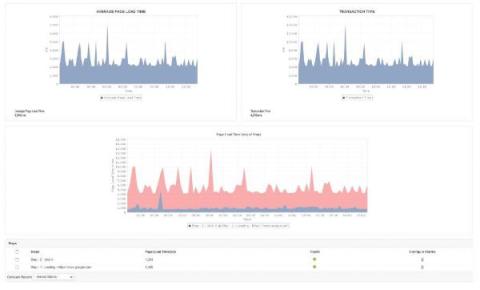
Digital experience monitoring (DEM) involves tracking the entire digital user journey of your applications, websites, APIs, and other digital services. It focuses on tracking the performance of your web application from the end user’s perspective, offering in-depth insights on user experience, app performance, and customer satisfaction.