Operations | Monitoring | ITSM | DevOps | Cloud

Applying AIOps to Logs Is Key for Observability

Logging is an essential method to understanding what’s happening in your environment. Logs help developers and system administrators understand where and when things have gone wrong. Ideally, logs on their own would suffice as indicators of what’s happening. However, there’s far too many log messages being produced in today’s world and most don’t contain the information we actually need.

We listened. Simpler Pricing. You're welcome.

I’ve tackled this question before: how much should my observability stack cost? While the things in that post are true now as ever, I did end on one somewhat vague conclusion. When it came to figuring out exactly what you need in your stack by drawing a straight line from the business case to the money you spend, my conclusion was that “it depends.” That’s how we approached pricing at Honeycomb: it depends on your needs, so we should give you many different options.

5 Reasons Why You Should Invest in a Docker Logging Tool

Today, continuous development and continuous delivery have become the de facto mode of application development for businesses seeking higher agility. With the continuous push to achieve higher efficiency and reliability in running software operations, container technologies like Docker, Kubernetes, and Mesos have become mainstream. Among these technologies, Docker is the most popular.

How to Effectively Monitor User Activity

Monitoring user activity on your website is a must if you want to run a successful and profitable online business. By implementing real user monitoring on your website, you can get an in-depth understanding of how your users are interacting with your website and the experience they receive. In this article, we discuss what real user monitoring (RUM) is and the benefits of using it. We’ll also share some best practices, so you’ll be ready to set up real user monitoring for your website.

Python Logging - The Ultimate Guide

This guide is focused on how to log in Python using the built-in support for logging. It introduces various concepts that are relevant to understanding Python logging, discusses the corresponding logging APIs in Python and how to use them, and presents best practices and performance considerations for using these APIs.

Grafana v7.0 released: New plugin architecture, visualizations, transformations, native trace support, and more

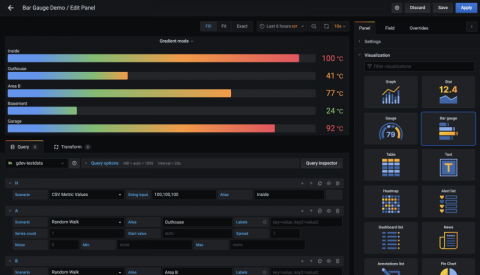
We are thrilled to announce that Grafana 7.0 has been released for general availability. Join us as Torkel Ödegaard, the creator of Grafana, hosts a full demo of 7.0 during GrafanaCONline today. With Grafana v7.0, our goal was to extend on the Grafana platform by making it easier and more consistent for existing users, and intuitive and simple for those not familiar with Grafana.

OpsLogix Ping Community Dashboard for SquaredUp

We are happy to announce that our widely popular free Ping Management Pack just got a community dashboard for SquaredUp. The dashboard is now available for download at SquaredUp Community site. The Ping Management Pack Dashboard includes one dashboard and one perspective. We would love to hear your feedback and listen to improvements to get this even better in the future.

ManageEngine recognized in Gartner Magic Quadrant for Application Performance Monitoring

We are happy to announce that ManageEngine has been recognized by Gartner in its 2020 Magic Quadrant for Application Performance Monitoring. Applications Manager has helped thousands of customers across the globe streamline and manage their servers and applications effectively.

Resolving the AddTrust External CA Root certificate expiration

Some of our users have received reports about their AddTrust External CA Root or USERTrust RSA Certification Authority certificate. The problem occurs because the remote server sends a root certificate in the chain that will expire in less than 14 days. Here are the steps to verify this and a few tips on how to resolve it.