Operations | Monitoring | ITSM | DevOps | Cloud

The Hidden Cost of Untagged Cloud Resources for SMBs

Cloud computing is a powerful enabler of growth and agility for small and medium businesses (SMBs). However, untagged cloud resources are one of the primary challenges most SMBs face in cloud environments. These untagged resources lead to a lack of visibility and accountability over cloud spending, which leads to wasted budgets and cost overruns.


Icinga Notifications v0.2.0 Release

Some of you might have already heard about this at OSMC, or you may have received a release notification from GitHub already: our Icinga Notifications project made a step forward and we are happy to announce that version 0.2.0 is now available for you to try out. It addresses feedback that we have received for the previous versions with the most important changes highlighted below.

Top 7 Observability Platforms That Auto-Discover Services

You can use an observability platform that automatically discovers your services and provides ready-to-use dashboards with minimal setup. If you're running a system where microservices come and go, containers shift around, or serverless functions scale up quickly, this kind of experience saves you a lot of time. You gain visibility as soon as something goes live, without requiring any additional steps on your part. In this blog, we talk about the top seven platforms that offer these capabilities.

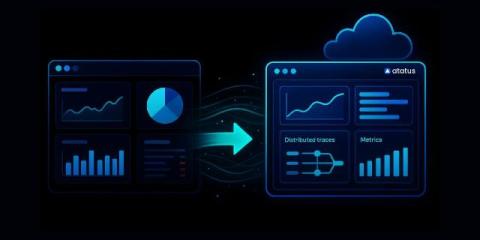
What to Expect When You Migrate to Atatus APM

As organizations aim for exceptional software reliability and user satisfaction, migrating to Atatus APM is a key upgrade in application monitoring. With nearly 80% of companies facing costly downtime exceeding $300,000 per hour, robust APM solutions like Atatus are crucial. It helps teams quickly identify bottlenecks, optimize performance, and improve the customer experience through comprehensive, real-time insights.

Stop the guesswork: Troubleshoot with confidence with process monitoring

If your organization runs on tech, everyday issues can be expected. This includes application downtime, erratic connectivity, and failures in remote access, database reachability, site-to-site VPNs, and web-based services. But how do you know if an issue is caused by: Sysadmins usually learn the root cause of an issue after a ticket comes in from the team or customer.

AI Isn't Here to Replace Your Dashboard... Yet

Non-deterministic UIs are the future and will replace your dashboards, but they’re not here yet. So until then, we’re stuck with conversational interfaces. In an effort to try and describe what I consider the future of UIs to look like, I wrote about how you (and I) have been designing dashboards wrong. The core insight was that we've been designing for static representations of data that sit on a TV in the office, when the actual use case is someone at a desk using them to debug an issue.

Architecture for the agentic era: How AI will reshape data, security, and observability

As AI agents move from copilots to autonomous systems, they’re generating and consuming data at unprecedented scale. The result is a new kind of infrastructure pressure — one that’s quietly reshaping how organizations think about data, cost, and control. Across IT, Security, and Observability, leaders are realizing a hard truth: too much data is too costly.

How to Choose the Best Synthetic Monitoring Solutions & Software

To have a fast and reliable experience digitally you would need to do more than resolving issues. This is why people prefer synthetic monitoring which simulates real user actions with regular intervals. Using this method, businesses can detect performance shortcomings and any technical issues. From testing website load to full flow checkout, everything can be tested before users face any issues.

AI for Good: Securing Networks in the Age of Autonomous Attacks

The rise of autonomous AI attacks operating at machine speed demands that network security evolve beyond human capacity and manual processes. Kentik AI Advisor counters this threat by using AI for good, reasoning across full network context to proactively eliminate vulnerabilities and guide immediate, confident defense.

AI Workload Infrastructure Requirements: What You Actually Need

Artificial intelligence (AI) infrastructure requires four pillars working in tandem as a system (compute, storage, networking, and orchestration) tailored to your actual workload needs, not hype. Artificial intelligence (AI) infrastructure isn’t just more hardware. It’s a new class of system—highly distributed, resource-intensive, and tightly coupled across compute, storage, and network layers.