Alexander is Senior SRE at Prezi, a video and visual communications software company. As a team, the Prezi SREs provide multiple services within the company. One of those is the observability stack where Prezi heavily relies on Grafana. Companies are always evolving to run more smoothly, serve their customers better, and operate in a way that is cost-effective.
Before we jump into the specifics of Grafana and Datadog, let's look at the main comparison points. Grafana is a great dashboard that allows you to plug in essentially any data source in the world. Grafana is most commonly paired with Prometheus, Graphite, and Elasticsearch to provide a full APM, time-series, and logs monitoring stack.
Prometheus is becoming a popular tool for monitoring Python applications despite the fact that it was originally designed for single-process multi-threaded applications, rather than multi-process. Prometheus was developed in the Soundcloud environment and was inspired by Google’s Borgmon. In its original environment, Borgmon relies on straightforward methods of service discovery - where Borg can easily find all jobs running on a cluster.
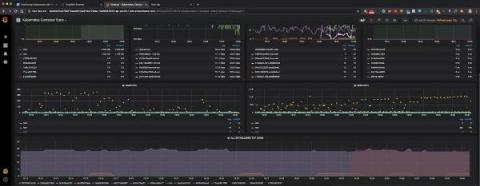
In this article, we will be covering how to monitor Kubernetes using Graphite, and we’ll do the visualization with Grafana. The focus will be on monitoring and plotting essential metrics for monitoring Kubernetes clusters. We will download, implement and monitor custom dashboards for Kubernetes that can be downloaded from the Grafana dashboard resources. These dashboards have variables to allow drilling down into the data at a granular level.
A look at what Arrow is, its advantages and how some companies and projects use it. Over the past few decades, using big data sets required businesses to perform increasingly complex analyses. Advancements in query performance, analytics and data storage are largely a result of greater access to memory. Demand, manufacturing process improvements and technological advances all contributed to cheaper memory.
Virtual machines give you a flexible and convenient environment where people can access different operating systems, networks, and storage while still using the same computer. This prevents them from purchasing extra machines, switching to other devices, and maintaining them. This helps companies to save costs and increase task efficiency. Although using VMs for everyday tasks may be enjoyable, ensuring consistent performance and performing maintenance can be daunting.