The latest News and Information on Monitoring for Websites, Applications, APIs, Infrastructure, and other technologies.
I’ve been contributing to, and creating, Splunk apps for the better part of the last 10 years. But never have I felt more excited to be a Splunk Developer than right now. One of the primary reasons why I am so excited is because of build tools like @splunk/create. At Splunk, we recognize that developers are so crucial to our entire ecosystem.
By now, you’ve likely heard of AIOps, a technique that promises to inject new levels of efficiency into IT operations with the help of AI and machine learning. But what, exactly, does AIOps mean in practice? Which specific use cases can IT organizations enable or improve with the help of AIOps? Those may be more difficult questions to answer if you have yet to see AIOps at work in your organization.
As most people were preparing to celebrate the new year, the UK’s Santander Bank was dealing with a crisis. On Christmas day, roughly 75,000 people who received payments from companies with accounts at Santander Bank received a duplicate payment transaction. The total damage amounted to £130m, and recovery in these situations is a painful process for both the bank and its customers.
You need not fear a long-lived streaming workload. A few simple tricks can transform a request that may not ever terminate for hours or days into something you can get regular health and status updates on. We in fact have one of those continuous processing services—Beagle, our Service Level Objective stream processor—which we’ve instrumented in this fashion.
We are proud of our many customers and users around the globe that trust Icinga for critical infrastructure monitoring. That´s why we´re now showcasing some of these enterprises with their Success stories. It´s stories from companies or organizations just like yours, of any size and different kinds of industries. Some of them are our long-standing customers, others have just recently profited from migrating from another solution to Icinga.
Thomas Stringer has a couple of great blog posts on how to understand your Azure monitoring costs and also on how to reduce your costs, see Azure Monitor Log Analytics too Expensive? Part 2 – Save Some Money | Thomas Stringer (trstringer.com). In the past I’ve blogged on How to calculate the Azure Monitor and Log Analytics costs associated with AVD (not an easy task!).
In the last few years, many organizations I worked with have significantly increased their cloud footprint. I’ve also seen a large percentage of newly launched companies go with cloud services almost exclusively, limiting their on-premises infrastructure to what cannot be done in the cloud — things like WiFi access points in offices or point of sale (POS) hardware for physical stores.
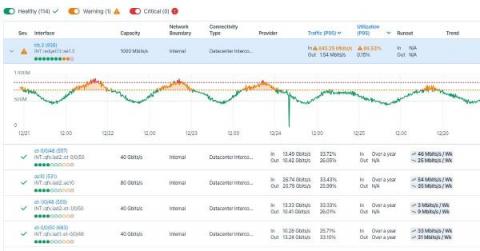
Didn’t quite get to that task of capacity planning in December? Well, not to worry, this month Kentik has overhauled our Capacity Planning workflow and is introducing a slew of new features to make capacity planning easier and more intuitive than ever before. Those who are familiar with Kentik will know that one of our core offerings is the ability to monitor and plan actual network and interface utilization.