Operations | Monitoring | ITSM | DevOps | Cloud

Sentry's AI debugger now references traces for troubleshooting distributed systems

Debugging is an ever-present pain for all developers, and that will continue despite, or maybe even thanks to, the rise of AI-written code. Tools like Sentry have been around for a while to help us engineers track and debug issues, but it’s tempting to make that process even faster and easier with some shiny new AI tools. Sure, I could just copy-paste the exception’s stack trace from Sentry into ChatGPT, but what if I really wanted something smart?

A Guide to OpenTelemetry Tracing in Distributed Systems

Understanding what’s happening inside your applications is key to keeping them performing well and reliably. OpenTelemetry tracing is an open-source, flexible solution that lets you monitor your distributed systems without locking you into a specific vendor. reliably This guide walks you through everything you need to know about OpenTelemetry tracing, from the basics to more advanced techniques, with practical tips for troubleshooting common issues along the way.

12 OpenTelemetry-Compatible Platforms You Should Know in 2025

OpenTelemetry has transformed how engineering teams implement observability. This vendor-neutral framework for collecting metrics, traces, and logs has become indispensable for several reasons: Elimination of vendor lock-in Organizations can switch observability providers without changing instrumentation code, enabling greater flexibility and negotiating power with vendors.

Is OpenTelemetry ready for Infra Monitoring?

“A system is never the sum of its parts; it's the product of their interaction.” — Russell Ackoff, Systems Thinker Infrastructure monitoring is an attempt to capture and record the product of interactions between various systems. Infrastructure monitoring comes across as challenging and tedious, often spread across multiple tooling system.

Prometheus Distributed Tracing: An Easy-to-Follow Guide for Engineers

When your microservices architecture starts growing, tracking requests as they bounce between services becomes a real headache. You know the feeling—a user reports a slow checkout process, and you're left wondering which of your twenty services is the bottleneck. That's where distributed tracing with Prometheus comes in.
Sponsored Post

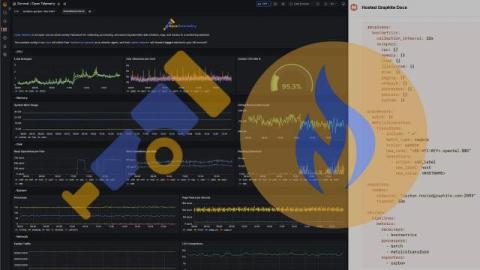
How to Configure OpenTelemetry as an Agent with the Carbon Exporter

If you're already using OpenTelemetry for tracing and logs, adding otelcol-contrib as an agent for system metrics just makes sense. It keeps everything in the same pipeline, so you're not juggling multiple monitoring tools or dealing with inconsistent data formats. Plus, with built-in support for host metrics, custom processing, and direct exports to Graphite, it's a solid way to ship performance data without extra overhead. In this article, we'll detail how to install the OpenTelemetry Collector Contrib distribution, and configure it to export system performance metrics to a Graphite datasource.

Correlation ID vs Trace ID: Understanding the Key Differences

You’re staring at logs, trying to figure out what caused that odd error in the middle of the night. Or maybe you're following a chain of requests across services, hoping to understand how one user action triggered a series of unexpected behaviors. That’s where distributed tracing and request tracking—specifically, correlation IDs and trace IDs—are invaluable. It’s the kind of detail that can make debugging faster and less painful.

All about OTel and Logging on Kubernetes with Loki (Loki Community Call April 2025)

In this pre-recorded Loki Community Call, we talk all about OTel and logging on Kubernetes with Cyril Tovena, Ward Bekker, Jay Clifford, and Nicole van der Hoeven at KubeCon EU 2025 in London. We discuss when why you should switch to OTel and why you shouldn't, what OTLP is exactly, and best practices for ingesting data through an OTLP endpoint.

How Does OpenTelemetry Logging Work?

Modern systems throw off logs like confetti—and making sense of all that noise is half the battle. OpenTelemetry logging offers a way to bring some order to the chaos. It helps DevOps teams collect logs in a consistent format, no matter what language or framework they’re working with. In this guide, we’ll walk through what OpenTelemetry logging is, why it matters, and how to put it to work in your stack.

OpenTelemetry vs APM - The Future of Application Monitoring Explained

Application monitoring is important for finding and fixing issues in modern software systems. Traditionally, teams have used Application Performance Monitoring (APM) tools to track application health and performance. These tools provide built-in features like dashboards, alerting, and error tracking. Now, OpenTelemetry is becoming popular as an open-source way to collect telemetry data like traces, metrics, and logs. It gives developers more control and avoids vendor lock-in.

An easier way to configure the OpenTelemetry SDK in your applications | Declarative Configuration

In this video, we'll explore OpenTelemetry's declarative configuration feature, a powerful new method to configure the OpenTelemetry SDK using a YAML file without the complexity and overhead of programmatic instrumentation. I'll demonstrate this with a simple Go application instrumented using declarative configuration, sending metrics, traces, and logs to Splunk Observability Cloud. We'll cover: Resources.

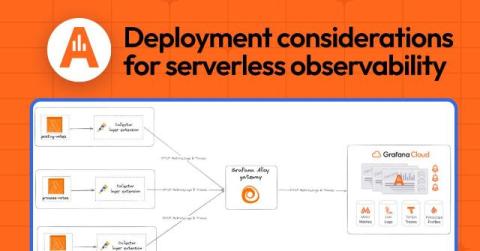
AWS Lambda, OpenTelemetry, and Grafana Cloud: a guide to serverless observability considerations

In our increasingly serverless world, observability isn’t just a “nice to have”—it’s essential. Serverless functions such as AWS Lambda bring incredible benefits, but they also introduce complexities, especially around monitoring and debugging. In a previous article, I provided a quick, practical guide for sending AWS Lambda traces to Grafana Cloud using OpenTelemetry.

OpenTelemetry for AI Systems: Implementation Guide

AI systems, from machine learning models to Large Language Models (LLMs) and autonomous AI agents, introduce unique observability challenges. Their non-deterministic nature, complex dependencies, and specialized performance characteristics require thoughtful instrumentation approaches. OpenTelemetry has emerged as the leading standard for implementing observability across these systems.

KubeCon 2025 London: OpenTelemetry Steals the Show and Splunk's Bold Moves

I was lucky enough to attend KubeCon Europe 2025 in London, where the energy around OpenTelemetry (OTel) reached fever pitch. From packed sessions to buzzing hallway conversations, it’s clear: OpenTelemetry isn’t just the future—it’s the present. Here’s what stole the spotlight.

OpenTelemetry's Hidden Superpowers: The OTEL Collector

Catch the replay of this in-depth and practical webinar where experts Nočnica Mellifera and María de Antón unveil the real power of the OpenTelemetry Collector. In this hands-on session, we cover: Whether you’re new to OpenTelemetry or deep into building observability pipelines, this session will help you fine-tune your setup, reduce noise, and boost performance.

Reducing Telemetry Toil with Rapid Pipelining

Intellyx BrainBlog by Jason English for Mezmo ‍ “Bubble bubble, toil and trouble” describes the mysterious process of mixing together log data and metrics from multiple sources as they enter an observability data pipeline. ‍ Customers demand high performance, functionality-rich digital experiences with near-instantaneous response times.

Announcing BYOC and the OpenTelemetry Distribution Builder

Instead of deploying a patchwork of proprietary agents for every platform, a telemetry pipeline lets you route your data through a single, consistent layer—and send it to any backend you choose. Flexibility, achieved. But there’s a catch. If your pipeline is proprietary, you’ve only shifted the lock-in left. Sure, you can now add or swap destinations freely—but you’re still deeply dependent on a vendor in the middle of your data flow.

Investigating an '[Object] not found' error in Next.js with Tracing in Sentry

Breakpoints and console.log statements might save your sanity during local dev, but production issues are another story. In prod, your errors might be distributed across different microservices, or hidden in minified code. Good luck hunting those down. That’s where Sentry’s traces and spans come in, offering you easy visibility into every network request, API call, DB fetch and more in a full-stack, distributed environment.