Operations | Monitoring | ITSM | DevOps | Cloud

The latest News and Information on Incident Management, On-Call, Incident Response and related technologies.
Automate Incident Management with PagerDuty Slack

Most organizations managing major incidents realized that every moment matters. Context-switching between different tools – with multiple web and chat surfaces having to be open to collect information causes friction. The cost of context-switching during an outage is even more painful. These are the problems that PagerDuty’s Slack Transformation just closed.

SSL Certificate Expiry Alerts in Slack

Certificate expiry is the most predictable outage in all of infrastructure. The date is printed inside the certificate. You can read it ninety days ahead. Nothing about it is a surprise, and yet SSL certificate expiry alerts remain one of the most common gaps in otherwise mature monitoring setups, and expired certificates keep taking down production systems at companies with serious engineering teams.

Google Calendar On-Call Rotation Template

Most teams building an on-call rotation template in Google Calendar get the first two steps right and the third one wrong. Creating a shared calendar is easy. Inviting the team is easy. Expressing "four people, one week each, forever, handing off Monday morning" as a set of recurring events is where it falls apart, usually into a mess of one off entries that someone has to rebuild by hand every quarter.

Cron Job Monitoring: Catch Silent Failures

Cron job monitoring is the part of observability most teams skip until a backup turns out to have stopped running three weeks ago. A web server that falls over generates errors, trips a threshold and pages someone inside a minute. A nightly job that quietly stops running generates nothing at all. There is no error rate to alert on, no latency spike, no failed health check. There is only an absence, and absence is invisible to almost every monitoring setup by default.

24/7 On-Call Coverage With a Small Team

Running 24/7 on-call coverage with a small team is first of all an arithmetic problem, and most teams avoid doing the arithmetic because the answer is uncomfortable. There are 168 hours in a week. Your engineers work roughly 40 of them. Somebody has to be reachable for the other 128, and if you have four engineers, that somebody is each of them, one week in four, thirteen weeks a year.

The AI Economy Has a Senior Engineer Problem. Here's How to Solve It

According to a 2025 report from Ravio, entry-level hiring (especially in engineering roles) has collapsed by more than 73% due to increasing AI capabilities. That means junior developer jobs are disappearing. At the same time, demand for senior engineers keeps climbing because organizations need more people to manage and optimize their complex AI agents.

ilert AI SRE is generally available

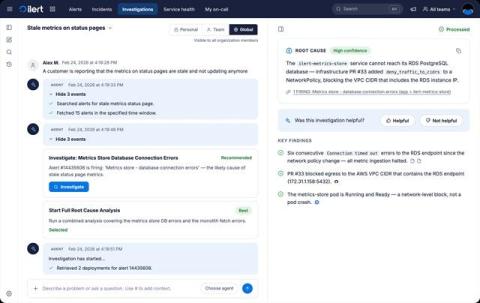
When you get paged at 3am, it takes about 30 seconds for the notification to reach you and maybe two minutes until you're in front of a laptop, awake enough to read. What you see then is usually a raw alert. A metric name, a threshold, a link to a dashboard. Then the ritual starts: open the dashboard, check what deployed in the last few hours, grep the logs for the first error, ask in Slack whether anyone touched the database. ‍ Most of that time is search.