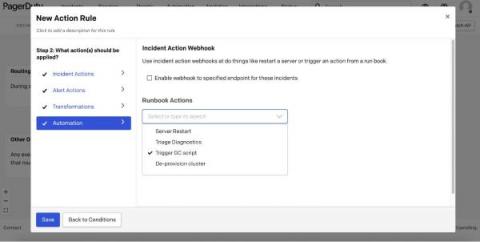
It’s 2022: You’re good at your job, you’re maintaining modern systems, now you want to level up your team based on a solid foundation of their collective expertise. You want to standardize and centralize process documentation and make execution as easy and effective as possible so that everything runs smoothly, every time.
We’re excited to announce a new set of updates and enhancements to the PagerDuty platform. Recent updates from the product team include On-Call Management, Event Intelligence, and Mobile Products, to PagerDuty Community & Advocacy Events.
When I first started out as an engineer I really leant in to the idea of what’s often called “being a hero”; I would get to the office a bit early to make sure I could fix anything that had gone wrong overnight. I loved the camaraderie of someone outside engineering bringing their laptop over with a critical process broken for me to fix (even if I’d been the one to break it!). Being a hero feels really good for a while, but over time, it loses its shine.
Hello and welcome to the fourth post in our EI Architecture series focusing on Intelligent Alert Grouping. Previously we have talked about how to train Intelligent Alert Grouping using incident merges (here) and how to configure your alert titles to improve default matching. In this post, we’re going to cover how service design can also impact your experience with Intelligent Alert Grouping as well as the PagerDuty app in general.
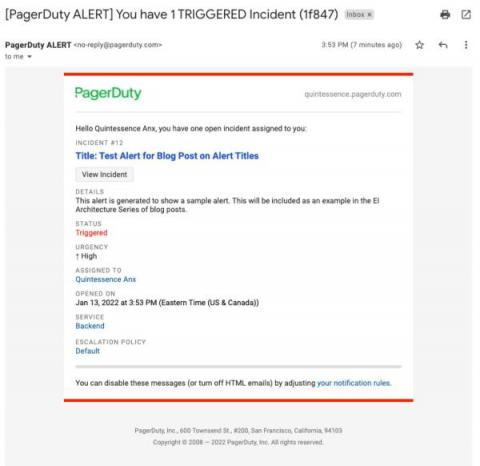
We’re continuing on with our third piece about how to utilize and improve your Intelligent Alert Grouping (IAG)! In case you missed it, the first two blog posts describe the feature (here) and explain how it uses merging to group alerts (here). We alluded to today’s post at the end of last: today we’ll be discussing how to use alert titles to improve IAG matches.
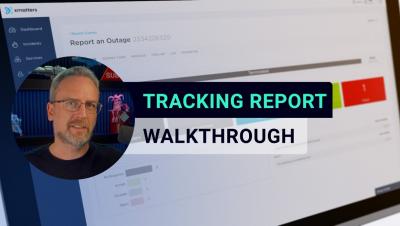
System outages happen to the best of us. Communicating with your customers and other stakeholders effectively during downtimes is vital to maintaining a solid relationship with them. When a system outage occurs, technical teams are tasked with swiftly locating the cause and resolving the issue, while communications teams are tasked with notifying stakeholders and customers about the outage to maintain transparency.
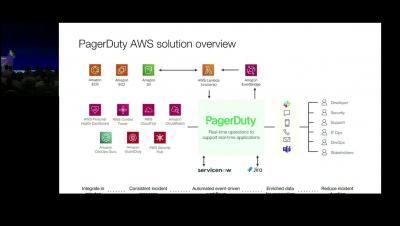
We often hear from customers that they’re dealing with unmanageable levels of noise and complexity, which makes it harder to pinpoint root cause and get to resolution quickly. All this effort spent on sifting through noise, processing events, and gathering context results in a lot of wasted time. That’s why we’ve launched Event Orchestration, which became generally available to our Event Intelligence and Digital Operations customers on Monday.
Using FireHydrant’s Runbooks, incident and retro data can be automatically sent to Confluence at any point in the incident lifecycle. For example, the moment you’ve resolved an incident FireHydrant can create a fresh Confluence page with all of the critical incident information stored in FireHydrant. When utilizing Runbook conditions, you can choose the perfect moment to send your FireHydrant retro to a Confluence workspace.
Reliability is a team game. More the collaboration between Developers and SREs, greater will be the success of the product. In this blog, we have listed down the five best practices that developers can adopt, to make the SRE's life easier. It is not easy to be a site reliability engineer. Monitoring system infrastructure and aligning them with the key reliability metrics is quite a daunting task. Whereas, a software engineer's job is to deliver high-quality software.
Mattermost Playbooks help software engineering teams orchestrate their work across all tools and teams to plan projects and hit milestones by uniting your tech stack through a single point of collaboration. We want to see how our community is leveraging Playbooks in their own tech stack and share your creations with everyone so the whole community benefits. We’re doing this by launching a new effort to commission original blog articles that show Playbooks in action.
This post provides an overview on the variety of options and to contact us, if you are seeking technical or other support from the SIGNL4 team. Though, SIGNL4 is designed as a self-service platform and provides an abundance of resources and help, we ‘human’ provide help through our agents whenever needed.
Episode 2 of Mooving to… dives into a new tool called Remix, a framework to help create front-end code, you’ll love. This episode focuses on a new web framework that helps streamline your processes and eliminate downtime to the best of your ability. Thom Duran and Andrew Leonard of Moogsoft are joined by Kent C. Dodds, Director of Developer Experience at Remix.
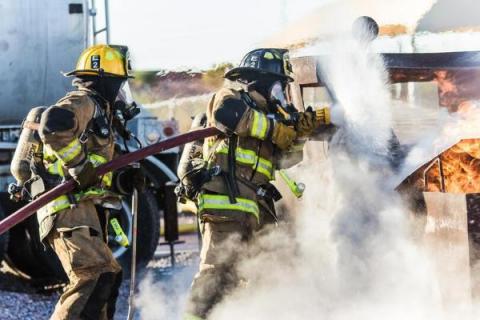
Many of the concepts SREs take for granted about incident management originated with efforts to fight fires in California in the 1970s.
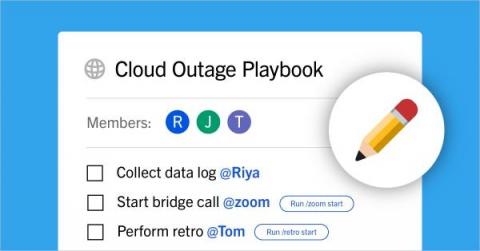
The goal of Mattermost Playbooks is to help teams consistently orchestrate any and all recurring workflows. A Playbook is a prescribed, repeatable process that a team has agreed on and formalized as a collaborative checklist saved on their Mattermost server. We at Mattermost use Playbooks for incident collaboration, customer onboarding, and product releases, along with many other complex processes.
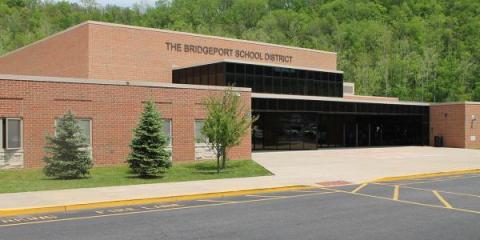
“I have been doing this for 20+ years and have been using literally every product out there. Derdack is unique at how issues are addressed and communicated out because of the seamless integration, maturity and flexibility of the platform. Working with Derdack has been a game changer for us and helped us to do more with less.” Jeff Postolowski, Director Information Technology Services, Bridgeport Public School District
When a service is down, a system is failing, or a security issue is in the midst of occurring, organizations need a solid incident response process to get up and running again. Incident response isn't just for high severity, lights out incidents either; if you've rebooted your computer to fix a problem, you've been an incident responder yourself! Incidents happen, and any successful organization knows that instead of pretending that one day nothing will ever go wrong, it's far more useful to develop a comprehensive operational response plan. And to do so, you need to know what incident response is! Let's get into it.
Incidents happen. Things go wrong. Systems fail. Sometimes they fail in unexpected and dramatic ways that create Major Incidents. PagerDuty makes a very specific distinction between an incident and an Incident. Your organization may also make such a distinction. Determining if an incident is major or not can come down to a number of factors, or a specific combination of factors, like the number of services affected, the customer impact, and the duration of the incident.
Judit Sharon, CEO and founder of OnPage Corporation, sits down with Healthcare Innovation to discuss how advanced, effective clinical communication systems help teams achieve ultimate patient satisfaction. How has the landscape around time-sensitive communications between and among clinicians and others in patient care delivery, evolved in the past few years?
Being in touch with your customers is key to any business. We at Derdack pride ourselves in being customer first when it comes to not only product enhancements and features but also support and building that customer/vendor relationship that lasts for years. We recently took a trip to Texas to visit several customers and the feedback was invaluable! We received a lot more information with a face-to-face meeting that just would not be the same if it were done virtually, like over Teams.
An overview of major IT incidents and outages in 2021
After two years of sky-high spending on cloud and related technologies, 2022 is the crunch point for corporate IT and digital leaders. Investments in technology helped facilitate the rapid shift to mass hybrid working and supported businesses to embrace the digital-first models of the new normal. But beyond merely investments to support new working styles, leaders also must ensure their organization continues to innovate.
Workflows are no stranger in the DevOps world. But where did this term come from, and what does it really mean? Perhaps it’s no surprise that workflows originated from the industrial revolution, which brought powerful machinery for mobilizing huge workforces unlike ever before. To maximize the potential of these new industrial tools, people had to first figure out the best way to use them to get work done as efficiently as possible.
At PagerDuty, we are committed to championing the customer — it’s a core company value. Our product has to provide great value, we have to provide excellent service, and we need to make it simple to do business with us. The Winter 2022 G2 Grid for AIOps Platforms Relationship Index showcases these values and highlights PagerDuty as a leading player in the AIOps space.
I am excited to announce today that BigPanda has secured $190 million in financing at a $1.2 billion valuation. This financing was led by Advent International and Insight Partners, together with our other existing investors. BigPanda is now officially a unicorn, and the clear leader in the rapidly growing AIOps market!
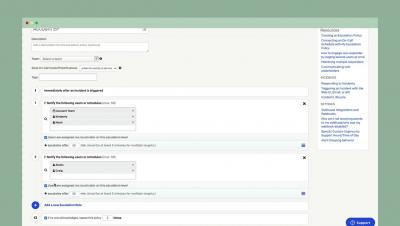
PagerDuty is excited to introduce Round Robin Scheduling. Round Robin Scheduling allows teams to equitably distribute on-call shift responsibilities amongst team members. Automatically assigning new incidents across different users or on-call schedules on an escalation level ensures that teams are resolving incidents as efficiently as possible. And, by balancing the workload across multiple users, there’s less risk of burnout.
Most support organizations today adopt some form of the traditional tiered support model. It is one that is based on a process of escalations and customer handoffs. Under this model, customer issues get escalated through multiple levels of a support hierarchy, with three tiers being a common workflow.
PagerDuty’s Operations Cloud helps organizations with critical work across the entire business, from IT teams to customer service to human resources, marketing, sales, and more. With PagerDuty, organizations can prioritize accurately, respond efficiently, and reduce operational overhead. In this blog post, we’ll share examples of how PagerDuty can be used for critical work in all departments, not just IT, using our new Solution Guides for Business.
Today’s organizations are managing increasingly complex IT ecosystems and pressured to deliver on innovation—all while trying to maintain service performance and reliability to keep up with the always-on digital economy. With IT complexity growing exponentially, incidents have become a common, if not day-to-day struggle for many businesses. Incident management is the process or method that modern organizations use to prepare for and respond to service disruptions.
Within DevOps, we talk a lot about the on-call process—but what about the human side of being on-call? For example, what are effective ways of managing stress and anxiety during a shift? How can one manage life situations that make being on-call difficult—such as being responsible for watching the kids during an on-call rotation? And how can an empathic team culture help prevent burnout and turnover?
The overall theme is high-performing engineering teams are generally the ones that humanize the process. Whether you’re trying to increase productivity or release better-quality code, the biggest piece of advice is to lead with empathy.
Incidents can have a massive impact on your operations, negatively affecting customers, employees, and stakeholders. Preparing in advance is the best way to restore normal service operations as quickly as possible.
We have released another update for Enterprise Alert 9 (version 9.2) which enhances the flood protection mechanism. This will help you to setup scenarios where you do not want the flood protection to be active for every notification channel. Read all details in this article.
When a cyber incident hits, there are certain questions that are asked right away almost every time...