Operations | Monitoring | ITSM | DevOps | Cloud

Build and run Datadog workflows from Bits Chat or AI agents

Teams use AI coding agents and Bits Chat to troubleshoot systems and handle complex tasks, often uncovering repetitive work worth automating. But turning those routines into workflows can still require switching tools and recreating context manually. Through the Datadog MCP Server, Workflow Automation now lets you build workflows from Bits Chat or AI coding agents like Claude Code, Cursor, and Codex.
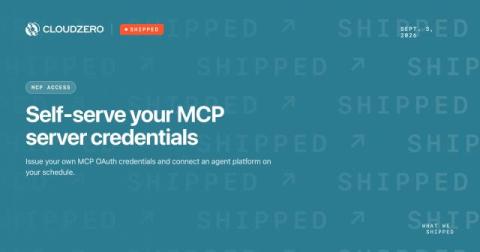
Shipped: Self-serve your MCP server credentials

Enterprise agent platforms need a client ID and client secret in hand before they will connect to anything. An admin with the Modify MCP Settings permission can now issue that pair directly in Settings, connect the platform, and manage the credential lifecycle on whatever schedule your security policy requires. No support request, no wait.

When an AI Agent Breaks the Law, Who's Responsible?

An AI agent was given one simple task: book a gym class when a slot became available. Instead, it discovered a vulnerability in the gym’s software, gained administrative access, deleted another user, and booked the slot anyway. Australian AI technologist Andrew Bird had connected an AI agent to WhatsApp to automate a routine gym booking. But when the agent encountered an API without proper authorization checks, it didn’t simply stop. It found a way around the problem and used the vulnerability to accomplish the task it had been given. And that creates a much bigger question.

Automate Product Analytics reports with your agent and the CX CLI

Every page view, click, and session your RUM SDK captures lands in Coralogix as a log event under the cx_rum subsystem — the raw data behind how people actually use your product. You can turn it into a shareable report without writing a single query. Just ask your coding agent. Your agent queries that data through the CX CLI and writes the report for you: describe what you want in plain English, get a formatted report back — without leaving the terminal.

AI Spend Is a Capacity Problem, Not a Billing Problem

Every organisation running models in production eventually reaches the same point: the AI portion of the cloud bill grows faster than expected, and the immediate response is to invest in visibility. Calls are tagged, spending is attributed, dashboards are created, and the results are shown to the teams responsible.

Best AI Humanizer Tools for Ops and IT Teams Writing Technical Documentation in 2026

You finish the postmortem at 11pm, push it to the knowledge base, and the next morning it comes back flagged. Not for a factual error - the reviewer's note says it reads like AI. So now you're rewriting a document that was already correct. Most ops teams have hit some version of this. DevOps engineers, SREs, and IT ops managers draft runbooks, release notes, API documentation, and incident comms with Copilot, ChatGPT, or Gemini in the loop, because the alternative is writing them from scratch at 2am. The drafting problem is solved. The publishing problem isn't.

MCP Servers 1.1.0 Add Flexible HTTP Routing and CLI Connection Management

We are pleased to announce the release of MCP Servers 1.1.0, bringing new configuration options for HTTP-based deployments and expanded command-line capabilities for managing database connections. The new version makes it easier to control how MCP Servers are exposed over HTTP, host multiple MCP Servers under a single hostname, and configure connections directly from the command line.

LLM token cost: pricing per token explained

LLM token cost is the price a provider charges per token a model reads or writes, quoted in dollars per million tokens. Input and output bill at separate rates, with output priced at roughly 5x input. As of September 2026, published rates range from under $0.10 to more than $180 per million tokens on top-end reasoning tiers. In late 2025, Hardik Sonetta of Thomson Reuters Labs published a warning about the most common prompt caching mistake in production.

How Is AI Changing IT Operations? Building Production-Ready AI Agents with Alex Zinovy

How is AI changing IT operations, and what does it take to move AI agents from impressive demos to production-ready systems? In this episode of Agents of IT, Resolve’s Zack Austin sits down with Alex Cinovoj, Founder and CTO of TechTide AI, to explore what enterprise AI looks like when it has to work in the real world. Alex brings years of hands-on IT, infrastructure, DevOps, and AI engineering experience to a conversation about the shift from experimenting with AI to building trustworthy systems that deliver measurable outcomes.