Mailchimp
Not subscribed to OpsMatters Newsletter


In this post, we’ll learn what Amazon Web Services (AWS) Lambda is, and why it might be a good idea to use for your next project. For a more in-depth introduction to serverless and Lambda, read AWS Lambda: Your Quick Start Guide to Going Serverless. In order to show how useful Lambda can be, we’ll walk through creating a simple Lambda function using the Python programming language. We’ll test it out, as well as take a look at what Lambda provides for metrics and logging.
Presto is an open source SQL query engine that runs analytics on large datasets queried from a range of sources, including Hadoop and Cassandra. Presto was originally developed by Facebook to run queries on its large Apache Hadoop data warehouse and is now used as an interactive analytics tool at companies like Airbnb, Uber, and Netflix.
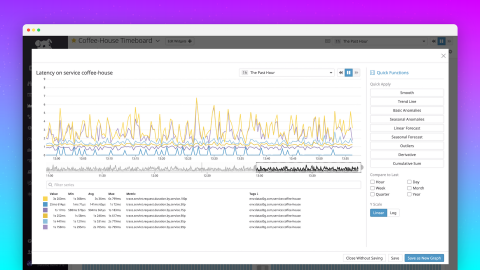
As you navigate through Datadog, you may find that you want to dive into a graph to explore your timeseries data more deeply, or make quick changes to a graph without permanently altering it. To make it easier to explore the data in your graphs, we’re excited to introduce a newly revamped full-screen view for our timeseries graphs. You can now quickly and easily apply functions, navigate through time to find anomalies, and save and share your work.
After stepping out for lunch, you return to find that Uptime.com has issued a downtime alert to your work email address. You’ve been away from your computer for about 45 minutes, blissfully unaware of your inbox and enjoying a moment of zen. Now that you’ve walked head-first into a small crisis, what’s the fastest way to confirm downtime, get server response codes, and perform outage analysis? We’ve got you covered with our real-time analysis tool.
Five worthy reads is a regular column on five noteworthy items we’ve discovered while researching trending and timeless topics. This week, we discuss whether NoOps is just a buzzword, a far-fetched reality, or simply the next evolutionary state of DevOps.
Early adopter enterprises across verticals such as Retail, Manufacturing, Oil & Gas are looking to incorporate containers and Kubernetes as a way of modernizing their applications. Choosing k8s as a standard ensures that these applications can be deployed these on different data center infrastructures (bare metal/VMware/KVM on OpenStack etc) or on public clouds (AWS/Azure/GCP etc).
In the old days of pushing tin and cardboard -- i.e., servers and packaged software -- it was comparatively easy to land a deal, hand the account from sales executive to post-sales engineering/support, then move on to the next opportunity. Today, in the cloud-enabled world, there is no more tin (unless you are a cloud or platform provider) and no more software DVDs in boxes. Software-as-a-service (SaaS) offerings require different customer engagement.
Would you know if your website went down? What would a potential customer think if they tried to access your website and found that it was offline? Would they return for a second time? Almost all businesses maintain some sort of online presence, and even for companies with large IT teams, it is simply infeasible for an individual or team to manually monitor the status of a particular website.