At Mattermost, we believe in the power of open source software and open companies. To this end, we’re thrilled to announce that we’ve been accepted into Google’s inaugural Season of Docs, a new program designed to highlight the promise of open source technology while raising awareness of the critical role docs and the technical writers who create them play in the success of open source projects.
The early adopters have begun to find a great degree of success and it is now time for the more mainstream enterprise to get off the proverbial wall and begin exploring containers and other areas of the cloud-native landscape. However, there is a need to mitigate or manage the risk of adopting new technology as it does introduce a dimension of change that accompanies any transformation.
With the adoption of agile microservices, enterprise IT teams have rapidly transitioned from managing pets (physical and virtual servers) to cattle (public cloud services) to now chickens (containerized infrastructure). Container platforms like Docker and container orchestration engines like Kubernetes are helping IT operators drive greater agility, portability, and flexibility for scaling, managing, and optimizing microservices architectures.
Everybody climb aboard the hype train with me. Today, we’re going to study a new job title: the DevOps engineer. This role is getting popular in the same way that the full-stack developer role became popular before it. In fact, one could argue that the DevOps engineer is an extension of the full-stack developer in that both seek to extend our ownership of our software.
Recently, while working with a customer, I saw a really cool use of PagerTree’s Stakeholder Notifications to send messages into a Slack channel. They did this by using the Slack’s Email to Slack integration along with PagerTree’s Stakeholder notifications. Today I’d like to share with you how they did it.
Today, I’m excited to announce a partnership between Logz.io and Microsoft Azure. With this partnership, Logz.io is now offering Azure customers a fully managed, scalable machine data analytics platform built on ELK and Grafana. What does that mean? Azure customers can now easily deploy, run, and scale ELK without the hassle and pain of maintaining and managing the stack themselves.
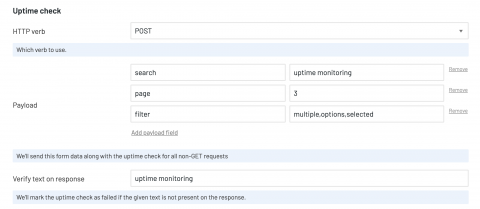
Next to our standard uptime monitoring through GET requests, we've added support for POST, PUT & PATCH methods too.
At Grafana Labs, we field questions about best practices from customers all the time. One company recently asked whether it should run a containerized Prometheus environment rather than a VM-based one. We thought we’d share our answer here too. So: Should you run Prometheus in a container?