Operations | Monitoring | ITSM | DevOps | Cloud

Okta: Atlassian product suite most popular app of the year

Atlassian and Opsgenie are among the most popular apps in the Okta network this year, according to a new report from the security company. From the report: Okta’s Business @ Work 2020 Report takes an in-depth look at how organizations and people work, exploring industries and customers, and the applications and services they use to harness productivity.

Using Auditbeat to protect your critical infrastructure

Beats are lightweight, purpose-built agents that acquire data and then feed it to Elasticsearch. Beats use the libbeat framework that makes it easy to create customized beats for any type of data you’d like to send to Elasticsearch. Auditbeat is a lightweight shipper from the Beats family that you can install on your servers to audit the activities of users and processes on your systems.

CNCF Member Webinar: DevOps Patterns and Antipatterns for Continuous Software Updates

So, you want to update the software for your user, be it the nodes in your K8s cluster, a browser on the user’s desktop, an app in the user’s smartphone or even a user’s car. What can possibly go wrong? In this talk, we’ll analyze real-world software update fails and how multiple DevOps patterns, that fit a variety of scenarios, could have saved the developers. Manually making sure that everything works before sending update and expecting the user to do acceptance tests before they update is most definitely not on the list of such patterns.

Kubernetes Master Class: How to harden your Kubernetes Clusters

As enterprises accelerate their adoption of containers and Kubernetes, they need to take necessary steps to protect such a critical part of their compute infrastructure. But not everyone has the same security needs, with developers and engineers often asking for different levels of granular control on specific configurations. This masterclass will help you navigate these conversations using Rancher’s current best practice security guidance. Topics to be covered will include:

Rancher vs. OpenShift - A Consultant's View

In any rapidly emerging market, consultants can be a great source for vendor-neutral insights, as they typically work with multiple technologies to help their customers make informed decisions. In that vein, Derya (Dorian) Sezen of kloia, a new-era consulting organization that provides services toward transition of legacy workloads to frontline technologies in Cloud, DevOps and Microservices, recently wrote a blog summarizing his experience with Rancher and Red Hat OpenShift.

Interlink Software Services | Your Digital Transformation Needs AIOps

Suffering from all too frequent, business damaging IT outages? Struggling to make sense of torrents of operational data and metrics? Overwhelmed by ever-increasing IT complexity and monitoring tool sprawl? Interlink Software is dedicated to helping IT teams in large, digital enterprises tackle these challenges and efficiently protect service availability. Your digital enterprise needs AIOps.

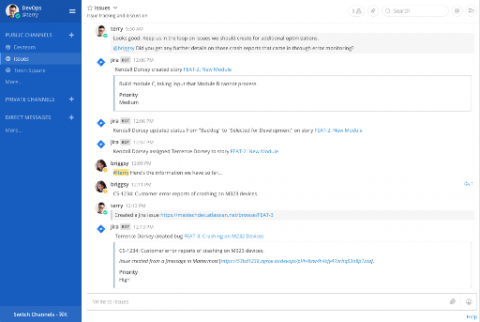
Accelerate DevOps workflows with the Mattermost Jira integration

Jira is one of the most popular platforms to plan software development work and to track work. Teams use Jira to create user stories, create and assign tickets, document and track issues and bug fixes, and track the entire development cycle from conception to release. Jira is incredibly useful, but it can also create a lot of email notifications whenever stories or tickets are added, changed, reassigned, or resolved.

Serverless Cost Optimization: Kinesis Streams vs Firehose

Serverless development opens lots of new opportunities, and if you’re invested in serverless (or you’ve been following the hype) you’ll know that cost efficiency is principal among those benefits. Simply put, we can save money by choosing the right tool for the right task. Since a distributed microservices architecture is made up of many managed services it’s a simple task to change out the building blocks of a particular application flow.

Getting AWS logs from S3 using Filebeat and the Elastic Stack

Logs from a variety of different AWS services can be stored in S3 buckets, like S3 server access logs, ELB access logs, CloudWatch logs, and VPC flow logs. S3 server access logs, for example, provide detailed records for the requests that are made to a bucket. This is very useful information, but unfortunately, AWS creates multiple .txt files for multiple operations, making it difficult to see exactly what operations are recorded in the log files without opening every single .txt file separately.