Application performance monitoring (APM) has become one of the key strategies adopted by IT teams and application owners in today’s era of digital business services. Application downtime has always been considered adverse to business productivity. But in today’s digital economy, what is becoming equally dreadful is application slowdown.
Heard of the prebuilt integration between Icinga and AlertOps? Icinga is an open source computer system and network monitoring application that is critical for your business.
Providing the ultimate customer experience is the goal of every modern company, and to do that they need complete visibility into every aspect of their business. At Sumo Logic, we make it our mission to democratize machine data and make it available for everyone, which allows organizations to gain the required visibility at each step. That’s why today, we are excited to announce the availability of Search Templates to our customers.
One of the cornerstones of a successful business in today’s digital environment is ensuring that web application performance is user-friendly and runs smoothly. A well-oiled website and its applications represent the face of a company, and in an ideal scenario, they serve as a mark of reliability, innovation, and progress.
In a world where IT infrastructure becomes more complex with each additional layer, knowing what is happening in your infrastructure becomes more complicated every day.
A wave of digital transformation is rolling in—a wave of universal connectivity, personalization, and adoption of intelligent technologies that many organizations have never navigated before. Adopting digital technologies often entails restructuring business verticals and scaling up data processing. One such vertical, IT operations (IT Ops), is finding it challenging to manually handle and process huge volumes of complex data.
Having hard time installing pinpoint? Pinpoint has started to support Docker. Visit our Official Pinpoint-Docker repository(https://github.com/naver/pinpoint-docker) for more information.
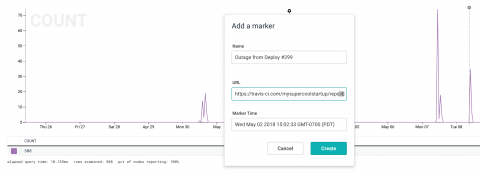
When it comes to observing systems, it helps to have tools that quickly and efficiently allow you to highlight events, anomalies, or simply changes to the code base. Enter Markers.
While logs can tell us whether a specific request failed to execute or not and metrics can help us monitor how many times this request failed and how long the failed request took, traces help us debug the reason why the request failed, or took so long to execute by breaking up the execution flow and dissecting it into smaller events.