

Operations | Monitoring | ITSM | DevOps | Cloud

Introducing Spike's new look: designed to scale.

Today, we are introducing Spike’s new logo, a new website, and honestly, a new identity from the ground up. This is very exciting day for all of us at Spike. More companies are being built today than at any other point in history. Small teams are making big products. And no matter the size of the team, every single one of them needs reliability. Reliability should not be a second-class citizen for any company, no matter where they are in their journey.
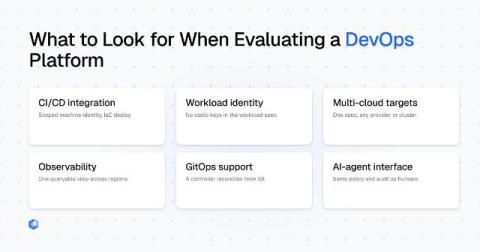
What to Look for When Evaluating a DevOps Platform

DevOps platform feature lists increasingly look alike. CI/CD, multi-cloud, observability, GitOps, and AI-friendly automation can all appear as checkboxes while the implementation burden still falls on your team. The useful signal appears when you ask how each capability actually works, what evidence a vendor can show, and which parts your team still has to build. Can pipelines authenticate with a scoped machine identity? Can workloads reach cloud APIs without static keys?

Build incident response workflows with Datadog Bits Chat

See how Bits Chat turns a natural-language request into an automated incident response workflow. In this demo, Bits Chat builds a workflow that investigates a monitor alert, identifies whether a recent deployment caused the issue, rolls it back when appropriate, and sends a summary to Slack.

Reliability Is the Test Agentic NetOps Has to Pass

It is 2:14 a.m. An agent has correlated a latency spike to an asymmetric routing condition and is ready to reroute traffic away from the affected path. The plan looks right. The only question that matters to the on-call SRE is whether to let it run, and that question is not really about the agent. It is about whether the picture the agent reasoned from is complete enough to trust at 2 a.m. with production on the line.

Introducing Swarm Investigation from BigPanda: Autonomous, multi-agent IT incident investigation

When a major incident opens, the opening minutes often become a race across disconnected tools and competing theories. One engineer checks a monitoring tool. Another scrolls through change records, looking for the one line that explains everything. A third pings Slack, asking if anyone has seen this before. While these are reasonable steps, taken one at a time, in sequence, they are far too slow.

How to verify your Azure Application Gateway is zone-redundant

Having a redundant failsafe is one of the best things you can do to ensure high availability in the cloud. It’s rare for cloud regions to go offline, but it can happen, even on major platforms like Azure. While you might not have control over your provider’s reliability, you do have control over your own, and redundancy is a key part of that. Here’s how you can check if your Application Gateways are availability zone (AZ) redundancy, and how to verify redundancy using active testing.

OnPage Mobile App User Guide

How to Use the OnPage Mobile App Get more out of the OnPage mobile app with this step-by-step walkthrough. In this video, we take an in-depth look at the app’s key features and show you how to use them, from managing alerts and responding to incidents to staying connected wherever you are. Whether you’re new to OnPage or looking for a quick refresher, this guide makes it easy to get started.

What is IPsec?

Our Megaport technical expert, Steve Tu explains what IPsec is, how it secures network traffic, and where it’s used across VPN and cloud connectivity. About Megaport Deploying infrastructure should be fast and simple. Megaport’s software-defined platform provides private compute, network, and storage — so you can build secure, scalable infrastructure for cloud, enterprise, and global AI inference workloads. Trusted by the world’s leading enterprises, Megaport operates across 1,200+ enabled locations globally.

Microsoft Took 8 Months to Fix This Copilot Vulnerability

Microsoft finally patched a critical Copilot vulnerability nearly eight months after researchers first disclosed it — and the way the attack worked raises some unsettling questions about AI memory. The vulnerability chained together multiple flaws that could allow a malicious prompt hidden inside a webpage to be pulled into Copilot simply by asking it to summarize the page. From there, the attack could potentially access connected data from services like Gmail, Google Drive, and Google Calendar and exfiltrate that information using Copilot’s own capabilities. But the most concerning part may have been persistence.