Serverless technologies let us do more with less effort, time and energy. They let us focus on creating user value and let the cloud handle undifferentiated heavy-lifting like scaling and securing the underlying infrastructure that runs our code. Serverless technologies have allowed me to accomplish tasks as a solo engineer that used to take a whole team of engineers to accomplish, and I’m able to complete these tasks in a fraction of the time and cost to my customers.
Over my time as a Sales Engineer and Partner Success Manager, I quickly learned that there are a few under-utilized features of N-sight RMM. While performing RMM dashboard audits, three of these features routinely came up in conversation with our partners. They include the Site Concentrator, Data Overdue Cross-Check, and Monitoring Templates. In this blog series, we will briefly cover uses in your day-to-day work and implementation of the features.
What’s autorun? Autorun is a feature of the Masterfiles Policy Framework (MPF)1 that simplifies the process of adding and executing new policy. We have talked about Modular policies with autorun and the Augments before. This time, we dig into autorun a bit deeper to explore some of its current features and look at how to implement your own as we did during The Agent is In, Episode 15 - Extending Autorun
If you are in a room with 20 engineers and you ask, “explain what an API is to a non-technical person”, you will get 20 different analogies. An API is like the on button to your TV connecting you to a variety of shows and systems, or an API is like a waiter taking your order and serving you from the kitchen. An API is like a library card catalog, or it’s simply a tool that connects you to other tools.
Does your development team want to snooze alerts during non-business hours? Or proactively prevent the creation of expected alerts for an upcoming expected maintenance window? Cloud Alerting in Google's Cloud operations suite now supports the ability to snooze alert policies for a given period of time. You can create a Snooze by providing specific alert policies and a time period. During this window, if the alert policy is violated, no incidents or notifications are created.
Learn how Obkio works with technology agency & major hosted VoIP Service Provider, bravad TI, to create a streamlined network monitoring and troubleshooting process to optimize VoIP performance & improve the end user experience.
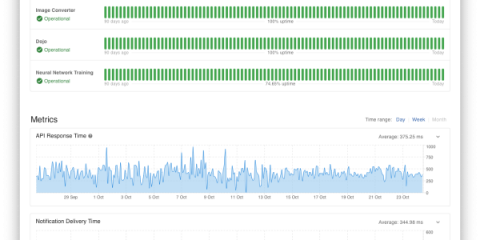
One of our goals here at Checkly is to make it easier for developers to ship excellent software. But let’s face it, getting features out is only a tiny fraction of the story. Fast-moving development teams also break things. And the more things you build, the more things can go wrong. And trust me, they will. This is where API and end-to-end monitoring helps. Define automated test suites that check all your properties constantly and guarantee that everything’s up and running. All the time.