Operations | Monitoring | ITSM | DevOps | Cloud

Un-observable AI is Un-trustworthy AI

Recently, someone talked Chipotle’s customer support agent into reversing a linked list – a task completely unrelated to burritos in any way. Screenshots circulated, people laughed, but underneath the joke sat a sharper question. If a production support agent will do that on a public channel, what else will it do that nobody is screenshotting? The bug is funny. The trust gap behind it is not.

Deep AI Investigation for ITOps: What It Is and Why It Matters

Investigation is the most time-consuming and cognitively demanding phase of incident response, and it’s the phase least served by existing tooling. Modern ITOps teams have spent years investing in better detection and alerting. The tools are faster, the dashboards are richer, and anomaly detection keeps improving.

Eight best practices for a successful cloud migration strategy

Moving to the cloud is one of the most consequential decisions an IT organization makes. A successful cloud migration strategy sets the foundation for how your business scales, innovates, and competes. But too often, cloud migration initiatives stall, underperform, or force organizations to repatriate applications back on-premises because the groundwork wasn’t laid correctly.

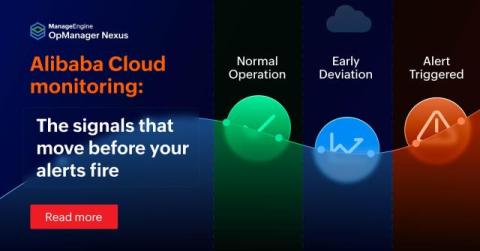
Alibaba Cloud monitoring: What changes when scale, speed, and cost collide

Alibaba Cloud monitoring isn't AWS or Azure monitoring with a different logo. The way its services scale, absorb load, and send early warning signals follows its own logic and if you're watching the wrong things, you'll find out too late. Cloud monitoring conversations often follow patterns set by AWS and Azure. The metrics are familiar, dashboards look the same, and operational playbooks are built around expected infrastructure behavior.

Troubleshooting website connection failures with website monitoring RCA

Every engineer has a story about the outage that came out of nowhere. One moment everything is green. The next, your monitoring dashboard lights up red, your inbox fills faster than you can read it, and somewhere a customer is staring at a blank screen wondering if your business still exists.

Troubleshooting website response time latency

Your dashboards may be telling a different story than what the customers are experiencing There's a version of a website problem that nobody talks about enough—the one where everything is technically fine. The site is up. The server is responding. No alerts have fired. And yet, somewhere out there, a user is watching a spinner rotate for the fifth second in a row, quietly losing faith in your product. This is what makes response time latency the most deceptive problem in web operations.

Product Update - June 2026

IncidentHub's latest product update includes private status ingestion for Microsoft Azure and Microsoft 365, a simpler UI for alerts configuration, an option to disable the public status page, and a better looking status page layout. Plus, support for more vendors (1070+ and counting). As always, I am grateful to all our customers and beta testers who have shared their feedback which has made IncidentHub better.

Shadow IT and Discovery AI Blind Spots: What Legacy Tools Miss

Ask three teams what assets exist in your environment, and you’ll get three different answers. Most organizations don’t lack tools. They lack agreement on what actually exists in their environment. Asset, endpoint and cloud data exist — but it’s fragmented, stale and trusted differently by teams across every department and function.

Find the Lookalike Domains Impersonating Your Brand: A Free Phishing & Typosquatting Scanner

Somewhere out there, a domain that looks almost exactly like yours may already be registered. Maybe it swaps one letter. Maybe it uses a Cyrillic character that is visually identical to a Latin one. Maybe it just adds the word "login" or "secure" to your brand. These lookalike domains are the raw material of phishing, and most companies have no idea how many exist for their brand until something goes wrong.