Operations | Monitoring | ITSM | DevOps | Cloud

ClickHouse LowCardinality: When It Helps and When It Hurts

ClickHouse LowCardinality cuts storage and speeds up queries on low-cardinality columns, but backfires on trace IDs. How to tell the difference. Prathamesh works as an evangelist at Last9, runs SRE stories - where SRE and DevOps folks share their stories, and maintains o11y.wiki - a glossary of all terms related to observability.
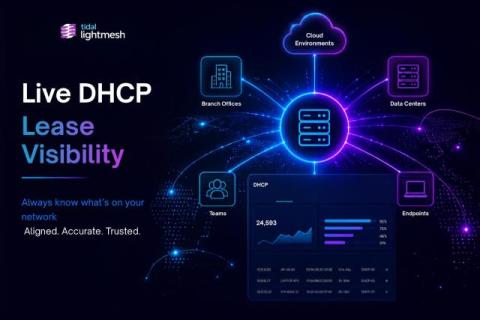
LightMesh DHCP Integration: Always Know What's on Your Network

Dynamic Host Configuration Protocol (DHCP) activity changes faster than most IP inventory systems can keep up. Devices reconnect. Leases expire. Infrastructure changes constantly across servers, endpoints, and cloud environments. If your IP inventory cannot reflect those changes automatically, teams quickly lose confidence in the data they rely on to operate the network.

Python Error Tracking for Django, Flask, and FastAPI: A Practical Setup Guide

Your Python app is throwing errors in production right now. Some of them are obvious: a 500 response, an angry Slack message from support. But most are quiet. A background task swallows an exception. A race condition surfaces only under load. A third-party API returns unexpected data and your code handles it by not handling it. If you’re relying on log files and user reports to find these, you’re debugging after the damage is done.

What is AWS Cloud WAN? Benefits, Use Cases, and Adoption Best Practices

Learn how AWS Cloud WAN works, key benefits, limitations, use cases, and adoption best practices. As AWS environments grow across multiple regions and accounts, networking can become increasingly difficult to manage. What starts as a handful of virtual private clouds (VPCs) can quickly evolve into a complex web of connectivity, routing policies, and security requirements.

Observability: Are You Measuring What Actually Matters?

Observability has always been important, and much like any core capability in your business, the value needs to be understood. For years, the value of observability was predictable. It was uptime, error rates, MTTR, and likely tool consolidation. That was enough to be able to show progress. These are foundational, tablestakes metrics—and they still matter, but they aren’t enough.

Without Governance, AI Is Just Faster Failure

Kellyn Gorman is a Database and AI Advocate and Engineer at Redgate She's the previous director of Data and AI at Silk, and the Oracle SME in Azure at Microsoft. With a robust background in cloud technology and a passion for promoting its merits and potential, I am thrilled to spearhead conversations and actions that help shape the future of this industry. Kellyn has authored numerous technical books, white papers and solution repositories in GitHub on database, AI and engineering topics.

Why Digital Operational Resilience Act (DORA) Compliance Requires Auditable Database Change Management

This article examines DORA's requirements for database change management and explains how Redgate Flyway Enterprise addresses them. The EU's Digital Operational Resilience Act (DORA) came into full effect in January 2025. It is designed to strengthen the ability of financial institutions to withstand operational disruption, whether caused by technology failures, data corruption, human error, or a cyberattack.

Introducing Kepler: The Delivery Engine for Agent-Driven Development

You’re no longer writing code. You’re managing a pipeline of agents writing it for you. If you’ve been running two, three, or four AI coding agents in parallel, you already know the problem. The agents are fast. The orchestration is chaos. You’re bouncing between terminal windows, manually rebasing branches, cleaning up messy commits, and trying to remember which agent is touching which repo.