Operations | Monitoring | ITSM | DevOps | Cloud

How AI Can Misinterpret Data and Lead to Errors

While AI systems can analyze vast amounts of data quickly, they may also misinterpret that data and lead to significant errors. Understanding how AI misjudgments occur will improve algorithms and ensure they provide accurate results. From biases in data to linguistic ambiguities, various factors can contribute to an AI's misinterpretation of information. Look closely at how these systems work and reveal why you should address these issues right below.

System Center 2025 Unveiled: Insights and Expert Discussion on SCOM, SCORCH, SCSM, and Beyond

The future of IT operations is here! Join us for an exclusive expert panel discussion on Microsoft System Center 2025, where industry leaders will explore the latest advancements and strategies for optimizing enterprise IT environments.

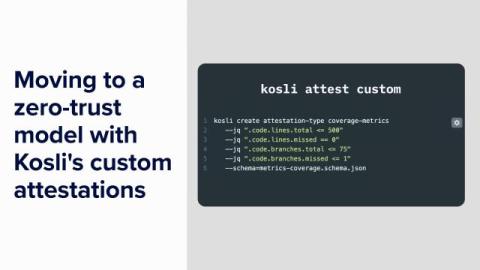
Moving to a zero-trust model with Kosli's custom attestations

The Kosli CLI provides several attest commands, such as kosli attest snyk, kosli attest jira, etc. These attestations are “typed” - each one knows how to interpret its own particular kind of input. For example, kosli attest snyk interprets the sarif file produced by a snyk container scan to determine the true/false value for that individual attestation.

Top 3 tools for reporting Zendesk metrics

Zendesk is a popular choice for customer service and support, offering a range of tools to manage interactions and boost customer satisfaction. However, making sense of all the data it collects requires robust reporting tools. Zendesk Explore, Power BI, and SquaredUp are three powerful tools that can help you unlock valuable insights from your Zendesk data, but each has its unique strengths.

A Complete Guide on Synthetic Monitoring | How to Improve Your Web & App Performance?

Making your brand stand out in digital business is more challenging than it sounds. More than 2.87 million apps are available on Play store and other platforms. In fact, as per reports, almost 252,000 new websites are created and launched daily. Competing in this large market without proper monitoring and strategy is a complete waste of time.

Announcing ARM builds in cloud for Bitbucket Pipelines

We are excited to announce the release of ARM builds in the Pipelines cloud runtime. Our release of Linux based ARM runners in cloud allows you to build and deploy software for ARM-based systems with all the benefits of our fully managed CI/CD platform. To use the new cloud ARM runners in your pipeline, make the following modifications to your bitbucket-pipelines.yml file.

Introducing step failure strategies in Bitbucket Pipelines

We are excited to introduce a new capability in Bitbucket Pipelines – Step Failure Strategies. This is the first of a set of new features allowing developers to implement more comprehensive logic and control-flow inside their CI/CD pipelines. Failure Strategies are designed to give you explicit control over how your pipeline behaves in the event that an individual step within the pipeline fails.

You Can Solve the Overprovisioning Problem

If you're like most companies running large-scale, data-intensive workloads in the cloud, you’ve realized that you have significant quantities of waste in your environment. Smart organizations implement a host of FinOps and other activities to address this waste and the cost it incurs: … and the list goes on. These are infrastructure-level optimizations.

A Leader's Framework for Enterprise AI Platform Investment

Almost every business needs AI, but it’s not needed everywhere. Yes, you read it right. AI, though it transforms entire business models, comes with a price tag. A 2022 survey by McKinsey found that only 27% of companies using AI have successfully scaled their initiatives across the organization. This highlights a key challenge—adopting AI without a clear strategy can lead to wasted resources and minimal return on investment.

Building Next-Generation SIEM Operations for Enterprise Security

Cybersecurity today is not just about defending against attacks. It’s about proactively managing risks in a landscape where threats are growing in volume and sophistication. With data volumes rising by 30% in just the past year and the average cost of a data breach now exceeding $4 million, traditional Security Information and Event Management (SIEM) systems are no longer enough.