Operations | Monitoring | ITSM | DevOps | Cloud

What is a Subnet Mask? Examples, Uses and Benefits

“What is a subnet mask?” is among the most common questions for aspiring network engineers. Network veterans have all been through it at one stage or another and we all have our tips and tricks for figuring them out. But, that initial understanding is typically a grind involving some combination of cheat sheets, IP to binary converters, books, articles, and online resources.

Open-source Telemetry Pipelines: An Overview

Imagine a well-designed plumbing system with pipes carrying water from a well, a reservoir, and an underground storage tank to various rooms in your house. It will have valves, pumps, and filters to ensure the water is of good quality and is supplied with adequate pressure. It will also have pressure gauges installed at some key points to monitor whether the system is functioning efficiently. From time to time, you will check pressure, water purity, and if there are any issues across the system.

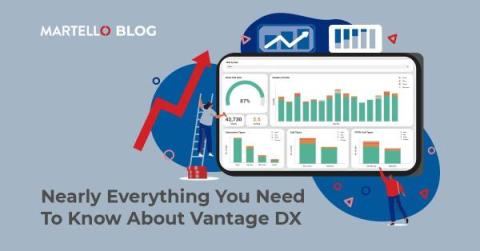
Nearly Everything You Need To Know About Vantage DX

Vantage DX, the only Experience Management Solution purpose-built for Microsoft Teams. This might well be your first-time hearing about Vantage DX. If it is…welcome! We’re here to help enterprises improve their communication and collaboration by giving them the tools they need to understand what is and isn’t working with their Microsoft Teams setup. Here’s just a quick starter to give you some idea of what Vantage DX is capable of.

This Earth Day, Gain New Sustainability Insights from your IT Infrastructure with OpsRamp and HPE

It’s April 22 and everybody knows today is Earth Day. But do you know how much energy your IT infrastructure is consuming and what that translates to in cost and carbon footprint? As we place more demands on our IT infrastructure to store and manage the reams of data we’re collecting and run advanced analytics and artificial intelligence on that data, we are inevitably consuming more energy in our data centers.

Revealing unknowns in your tracing data with inferred spans in OpenTelemetry

In the complex world of microservices and distributed systems, achieving transparency and understanding the intricacies and inefficiencies of service interactions and request flows has become a paramount challenge. Distributed tracing is essential in understanding distributed systems. But distributed tracing, whether manually applied or auto-instrumented, is usually rather coarse-grained.

How to Monitor & Identify Google Meet Performance Issues

Virtual meetings have become essential for businesses, connecting teams and enabling collaboration from anywhere. Google Meet has been a reliable platform for these meetings, but ensuring smooth performance requires some know-how. In this article, we'll break down how to monitor and identify Google Meet performance issues. Whether you're an IT professional, network admin, or remote user, this guide is tailored to help you optimize your virtual meetings.

Every second counts in our UI

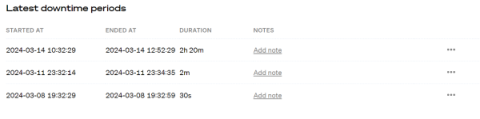
Downtime has always been shown in minutes, hours, and days but for shorter downtimes you would see "0m" even if the actual downtime was less than a minute. We've updated the UI to show downtime in seconds. This means no more manually calculating brief outages — you’ll see exactly how long the system was down :) Did you know you can add notes to downtime periods?

Introducing Relational Fields

We’re excited to bring you relational fields, a new feature that allows you to query spans based on their relationship to each other within a trace. Previously, queries considered spans in isolation: You could ask about field values on spans and aggregate them based on matching criteria, but you couldn’t use any qualifying relationships about where and how the spans appear in a trace.

Lessons learned from running a large gRPC mesh at Datadog

Datadog’s infrastructure comprises hundreds of distributed services, which are constantly discovering other services to network with, exchanging data, streaming events, triggering actions, coordinating distributed transactions involving multiple services, and more. Implementing a networking solution for such a large, complex application comes with its own set of challenges, including scalability, load balancing, fault tolerance, compatibility, and latency.