
Operations | Monitoring | ITSM | DevOps | Cloud

Implement Distributed Tracing with Spring Boot 3

A slow checkout request. A background job stuck waiting on another service. A log message that looks fine — until performance drops. In a Node.js microservices setup, these are the moments that test your observability. You know something's wrong, but tracing the request across dozens of services feels impossible. Distributed tracing changes that. It connects every span in the request's journey, showing exactly where time is spent and where things start to break down.
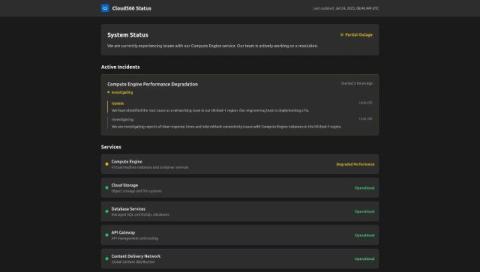
The 2025 Guide to Open Source Status Page Software

This is an updated version of the 2024 article. Maintaining transparent communication about service availability is crucial for businesses of all sizes. Status pages are an important part of your communication strategy during times of outages and maintenance events. You can choose to go with a fully managed status page provider or host an open-source one yourself.

CIDR blocks vs. IP ranges: Aligning network discovery with business value

At every turn, IT leaders are required to prove the value of every technology investment. Technology business management (TBM) practices encourage connecting tech spend directly to business outcomes, demanding accurate data about what’s in your network and how it supports the organization.

Monitor logs from Amazon EKS on Fargate with Datadog

Amazon EKS on Fargate is a managed service that reduces the operational overhead of maintaining a Kubernetes cluster by abstracting away the underlying infrastructure. In a serverless Fargate environment, each pod is assigned its own isolated compute resources; there is no direct host-level access.

Obkio's Visual Traceroute Tool: Feature Release

Today, Obkio’s Network Performance Monitoring solution is announcing the release of our all-new Visual Traceroute Tool integrated into Obkio’s application. This feature is a re-invention of Obkio’s standalone Visual Traceroute Tool (Obkio Vision), and has been transformed to help users better understand network path performance and the source of network issues.

What Is SolarWinds, And Should You Use It?

Downtime is brutally expensive and damaging. Enterprises can lose about $9,000 every minute systems are down, while smaller businesses lose hundreds of dollars per minute. A single outage can often cost over $100,000, and nearly a third of companies lose customers due to downtime. That’s why many organizations turn to platforms like SolarWinds to maintain reliable systems and minimize the risk of costly disruptions.

Managing observability costs at scale: A look at the latest cost management features in Grafana Cloud

The benefits of observability are clear: deep visibility into system health, faster troubleshooting, and improved reliability (to name a few). But what’s equally clear is that, as organizations scale and evolve their observability strategies, they need a way to tap into these benefits without runaway costs. According to Grafana Labs’ 2025 Observability Survey, 74% of respondents say cost is a top priority for selecting tools.

Distributed Historian Architecture with InfluxDB 3

From pipelines to warehouses, modern operations generate more distributed data than ever, with equipment and connected devices spread across factories, grids, and remote sites. A single, centralized historian can no longer handle this volume or distribution. Without change, organizations risk fragmented visibility, higher costs, and slower responses.

Choosing the Right APM for Go: 11 Tools Worth Your Time

If you’re building high-performance systems, Golang has probably earned a spot in your stack. Its speed, lightweight concurrency, and quick compile times make it ideal for scalable APIs, microservices, and distributed systems. But those same qualities that make Go powerful can make performance monitoring tricky. Goroutines run fast and in parallel, which means a simple CPU or memory graph doesn’t always tell you what’s slowing things down.