Building modern, cloud-native applications introduces new challenges to teams and organizations. As these systems grow and scale, struggles abound: inconsistent performance monitoring experiences across siloed tools, wasteful performance management practices with duplicated efforts, and mounting frustration from colleagues and customers. Surmounting these challenges requires multiple sources of data and truly unified observability.
We all know that observability is a must-have for operating systems in production. But we often neglect our own backyard — our software release process. We noticed we made that mistake here at Logz.io. We were wasting time and energy in handling failures in the CI/CD pipeline, and made our Developer-on-Duty (DoD) shifts tedious. That’s why it’s critical to incorporate your observability practices into your CI/CD pipeline.
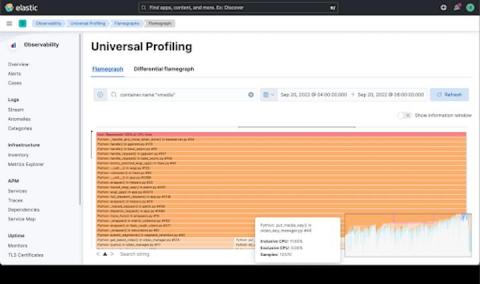
So, what is Universal Profiling™? Universal Profiling™ is fast emerging as an important component of observability. A standard feature inside hyperscalers since approximately 2010, the technology is slowly percolating into the wider industry. Universal Profiling™ allows you to see what your code is doing all the time, in production across a wide range of languages and can profile both user-space and kernel-space code.
From its inception as a powerhouse for logging, Elastic Observability has grown into a comprehensive solution for full-stack multi and hybrid-cloud observability. Given the increasing complexity of the cloud-native world, the major challenge for observability is twofold: getting deeper and more frictionless visibility at all levels of applications, services, and infrastructure, and making sense of the overwhelming amount of data that is available.
Debugging is an unavoidable part of software development, especially in production. You can often find yourself in “debugging hell,” where an enormous amount of debugging consumes all your time and keeps the project from progressing. According to a report by the University of Cambridge, programmers spend almost 50% of their time debugging. So how can we make production debugging more effective and less time-consuming?
Another month has come to a close, so I’m back again to take you through what’s new and noteworthy from the month of September. If you missed last month’s blog, this will be a monthly recurring series to keep you posted with the latest and greatest at Honeycomb. There’s a ton to cover, so I’ll dispense with the preamble and dive right in.