Operations | Monitoring | ITSM | DevOps | Cloud

Enhance the Value of Your Data With Mezmo's Observability Pipeline

Organizations of all sizes rely on their observability data to drive critical business decisions. Production Engineers across Development, ITOps, and Security use it to understand their systems better, respond to issues faster, and ultimately provide more performant and secure user experiences. But while the value of observability data is well understood, teams struggle to derive value from it.


New Honeycomb Features Raise the Bar for What Observability Should Do for You

As long as humans have written software, we’ve needed to understand why our expectations (the logic we thought we wrote) don’t match reality (the logic being executed). To that end, we developed techniques to help measure reality—logging text strings, or capturing aggregated metrics—and persevered, seeking out newer and fancier logging or monitoring solutions over the intervening decades.

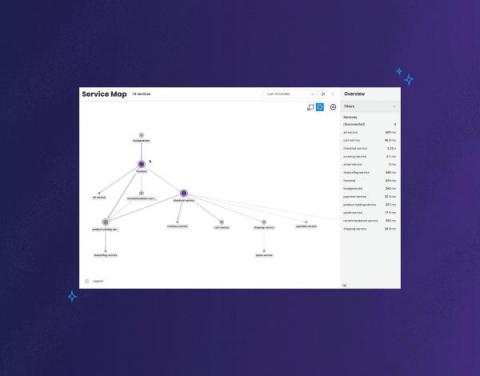
Introducing Honeycomb Service Map: A Dynamic, Interactive, and Actionable View of Your Entire Environment

Today, we're announcing the launch of Honeycomb Service Map. This isn't your grandparent's version of a service map. This feature reimagines what it is that you want to know or investigate when looking at visualizations of how your services communicate with one another.

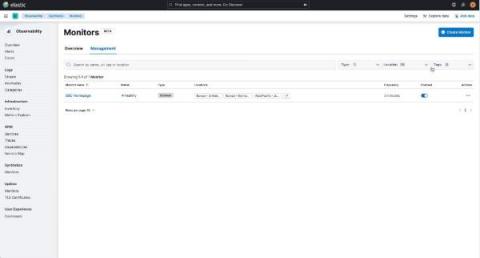
Observing your application through the eyes of a user: A brand new synthetic monitoring experience is coming

Understanding if your applications are not just available but also functioning as expected is critical for any organization. Third-party dependencies and different end-user device types means that infrastructure monitoring and application observability alone are not enough to spot and minimize the impact of application anomalies.

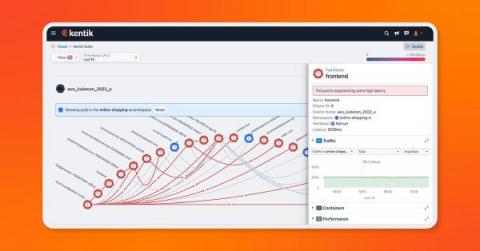
Kentik Kube extends network observability to Kubernetes deployments

We’re excited to announce our beta launch of Kentik Kube, an industry-first solution that reveals how K8s traffic routes through an organization’s data center, cloud, and the internet. With this launch, Kentik can observe the entire network — on prem, in the cloud, on physical hardware or virtual machines, and anywhere in between.

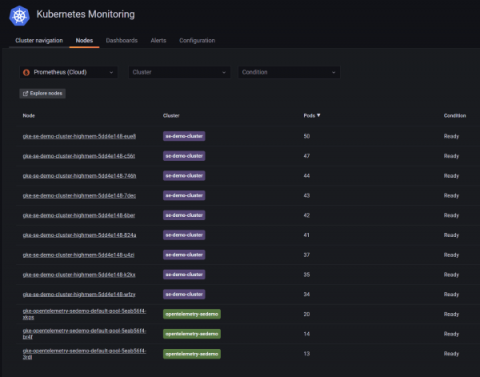
How to monitor the health and resource usage of Kubernetes nodes in Grafana Cloud

The spine is essential to perform every activity, like crawling, walking, or swimming. Just as the spine is necessary to enable these functions, your Kubernetes infrastructure needs a backbone to be efficient and effective. So if Kubernetes clusters act as the spine of your architecture, then Kubernetes nodes are like the vertebrae — they make up a Kubernetes cluster in the same way the vertebrae form the spinal column.

Announcing New GitHub Actions + Honeycomb Integration Guide

If you build or maintain code in GitHub, the Honeycomb Buildevents Action can help you optimize the performance of your build pipelines in GitHub Actions. This blog introduces you to the gha-buildevents Action and a new hands-on quickstart guide that will show you the inner workings of GitHub Actions workflows, the buildevents tool, and the Honeycomb UI.

Grafana and Cilium: Deep eBPF-powered observability for Kubernetes and cloud native infrastructure

Today, Grafana Labs announced a strategic partnership with Isovalent, the creators of Cilium, to make it easy for platform and application teams to gain deep insights into the connectivity, security, and performance of the applications running on Kubernetes by leveraging the Grafana open source observability stack.

Import Datadog Traces Into Honeycomb

Getting existing telemetry into Honeycomb just got easier! With the release of the Datadog APM Receiver, you can send your Datadog traces to the OpenTelemetry Collector, and from there, to any OpenTelemetry-compatible endpoint. Often, evaluating a new tracing solution requires re-instrumenting your applications from the ground up in a new vendor’s tooling. It’s a pretty high bar to clear just to see if a solution is worth adopting.