Operations | Monitoring | ITSM | DevOps | Cloud

Tracing without Limits: live-query all traces, retain only the ones you need

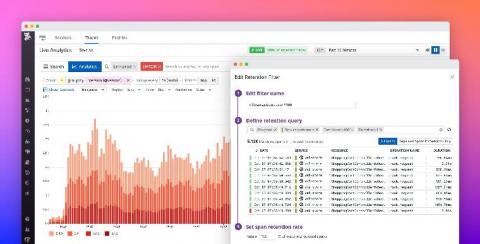
Tracing is a critical part of monitoring application performance, especially as organizations shift to deploying services using distributed systems, serverless computing, and containerized environments. Teams need real-time, end-to-end visibility into all of the traces relevant to performance issues such as an application outage or an unresponsive service, but managing tracing costs often results in gaps in valuable tracing data.


Announcing Native OpenTelemetry Support in Splunk APM

At Splunk, we've been leading the way in observability and helping accelerate the adoption of the OpenTelemetry project. With the trace specification reaching a stable maturity level and several SignalFx Gateway and client library capabilities being upstreamed, we're ready to go all-in while we continue accelerating the growth and adoption of OpenTelemetry beyond the commitments we made last year.

Jaeger Essentials: Distributed Tracing from Dapper to Jaeger

If you are dealing with microservices, serverless architecture, on any other type of distributed architecture, you have probably heard the term “Distributed Tracing.” You may have been wondering what it’s all about, and where should you start, in this post, I’ll tell you about the journey we passed at Duda, from the day we heard about distributed tracing and started to explore whether it will be useful to use it in our company, to the exploration on what is distributed tracing a

A Guide to Deploying Jaeger on Kubernetes in Production

Logs, metrics and traces are the three pillars of the Observability world. The distributed tracing world, in particular, has seen a lot of innovation in recent months, with OpenTelemetry standardization and with Jaeger open source project graduating from the CNCF incubation. According to the recent DevOps Pulse report, Jaeger is used by over 30% of those practicing distributed tracing.

Adding Tracing with Jaeger to a TypeScript express application

I have been following distributed tracing technologies — Zipkin, OpenTracing, Jaeger, and others — for several years, without deeply trialing with any of them. Just prior to the holidays, we were having a number of those “why is this slow?” questions about an express application, written in typescript, providing an API endpoint.

Can Distributed Tracing Replace Logging?

Logging has been around since programming began. We use logs to debug issues and understand how software works at the code level. After logging and debuggers, profilers are a dev’s best friend when writing code and may run in production with limits to reduce overhead. As we distributed architectures — making systems more complex — centralized log aggregation was soon necessary. At that point, we had to analyze this data. Hence, log analytics technologies were born.

Logs and Traces: Two Houses Unalike in Dignity

Intelligent Medical Objects (IMO) and its clinical interface terminology form the foundation healthcare enterprises need, including effective management of Electronic Health Record (EMR) problem lists and accurate documentation. Over 4,500 hospitals and 500,000 physicians use IMO products on a daily basis. With Honeycomb, the engineering team at IMO was able to find hidden architectural issues that were previously obscured in their logs.

Monitoring Java applications with Elastic: Multiservice traces and correlated logs

In this two-part blog post, we’ll use Elastic Observability to monitor a sample Java application. In the first blog post, we started by looking at how Elastic Observability monitors Java applications. We built and instrumented a sample Java Spring application composed of a data-access microservice supported by a MySQL backend. In this part, we’ll use Java ECS logging and APM log correlation to link transactions with their logs.

Jaeger Essentials: Jaeger Persistent Storage With Elasticsearch, Cassandra & Kafka

Running systems in production involves requirements for high availability, resilience and recovery from failure. When running cloud native applications this becomes even more critical, as the base assumption in such environments is that compute nodes will suffer outages, Kubernetes nodes will go down and microservices instances are likely to fail, yet the service is expected to remain up and running.

Configuring the OpenTelemetry Collector

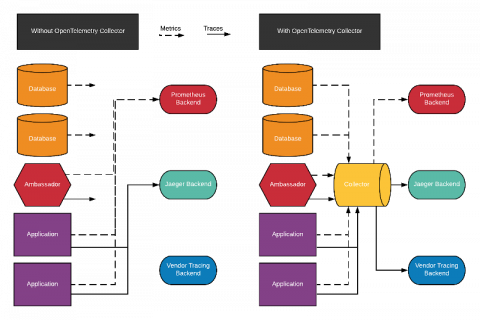
The OpenTelemetry Collector is a new, vendor-agnostic agent that can receive and send metrics and traces of many formats. It is a powerful tool in a cloud-native observability stack, especially when you have apps using multiple distributed tracing formats, like Zipkin and Jaeger; or, you want to send data to multiple backends like an in-house solution and a vendor. This article will walk you through configuring and deploying the OpenTelemetry Collector for such scenarios.