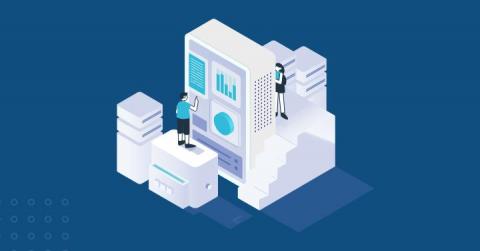
A Data Pipeline is a series of processes that collects raw data from various sources, filters the disqualified data, transforms them into the appropriate format, moves them to the places you want to store them, analyzes them, and finally presents them to your audience. As we can see in the chart above, a data pipeline is analogous to a water flow: data flows from one stage to another while being processed and reshaped.
2022 is right around the corner, and it’s not just time to prepare for christmas, play video games, buy presents, or share anti-christmas memes. It’s time to start making some predictions for bare metal Kubernetes! Take a minute and let’s think about it. Developers have advent of code so they’re busy right now. Sysadmins and devops can play games like predicting what’s going to happen next year for bare metal Kubernetes.
Liesse Jones: Steve Pereira is a DevOps enthusiast and an expert in software team performance. He leads the largest DevOps community in Canada and is the founder of Visible, where he coaches teams to boost flow and value using his four key maps of DevOps. Welcome to DevOps State of Mind, a podcast where we dive deep into the DevOps culture and chat with friends from small startups and large enterprises about what DevOps looks like in their organizations. I'm Liesse from LogDNA.
As a Solution Architect here at xMatters, an Everbridge Company, and through my 30-year career in the IT industry, I've seen many frameworks offering bold new ideas. CMMI, ITIL, Prince 2, Agile, Scrum, and most recently, DevOps. These frameworks come and go, offering huge improvements in the way we deliver and manage our IT capabilities, but never lasting long enough to act on those promises. That's not to say they haven't made a marked difference in the IT space, or that they haven't been hugely impactful for organizations around the globe. They become launching off points for a new framework, and now there's a new term that's appeared, DevSecOps.
The Internet of Things (IoT) is a term that describes the increasingly sophisticated ecosystems of online, connected devices we share our world with. The slightly odd name refers to the fact that the first iteration of the internet was simply a network of connected computers. As the internet grew, phones, office equipment like printers and scanners, and industrial machinery were added to the internet.
Heroku is a cloud-based platform that helps companies build, deliver, monitor, and scale applications with high velocity. Heroku's popularity is due to its simplicity, usability, elegance, and focus on the developer experience. Developers find Heroku helpful as they can get their application ready and running with only minimal focus on configuring infrastructure. Heroku scores on easiness in architecting apps, deploying them to flexible cloud infrastructure, and scaling them as required.
Many organizations aspire to a world where everything is in the cloud. But, in reality most IT enterprises still rely on traditional on-prem monitoring technologies. As a market-leading monitoring tool, SCOM is ideally placed for the job; monitoring both on-prem workloads or workloads that link up to the cloud. So, as SCOM is central to most companies’ monitoring, it is essential you understand how to be successful with SCOM!
Understanding the relationship between Service Management and Project Management is a topic of interest for many people because, at first glance, both techniques appear to be competing for the same workspace in many organizations. They are critical practices for every business to develop and prosper. So, although project management and service management may sound similar, there are several key distinctions between the two concepts.