Operations | Monitoring | ITSM | DevOps | Cloud

The latest News and Information on DevOps, CI/CD, Automation and related technologies.

[DEMO] Komodor Agentic Operations Platform

The Komodor Agentic Operations Platform allows enterprises to confidently implement autonomous operations in mission-critical environments, fully governed from the first run. Get started instantly with pre-built, end-to-end agentic workflows, along with the shared infrastructure, tools, MCP gateways and integrations needed to build, run, and optimize your own.

[WEBINAR] Introducing the Komodor Agentic Operations Platform

Join Komodor CTO and co-founder Itiel Shwartz for a live look at the newly launched Komodor Agentic Operations Platform. Itiel will guide us through where agentic AI operations are headed in 2026 and beyond, and how Komodor got here: years spent resolving incidents in some of the world’s largest production environments, and what that experience revealed about what makes agents valuable in production.

Your AI coding gains are stuck before the code is even written

At some point this year, you likely approved a request to expand AI coding tool access across the team. The pitch was straightforward: engineers write code faster, the team ships more, the investment pays for itself. The first half happened. Engineers are writing code faster. If you're now being asked whether the investment paid off, and you're finding the honest answer is more complicated than a yes, you are not alone, and you have not been sold something broken.

How Harness orchestrates LLM security scanning

Large language models are effective at security review for the same reason they are effective at many other tasks: they reason rather than pattern match. In plain terms, a traditional scanner checks code against a list of known bad patterns, the way a spell checker flags a misspelled word, regardless of what the sentence means. An LLM can instead follow the program's logic: trace a piece of attacker-controlled input through several layers of application code to determine whether it is reachable.

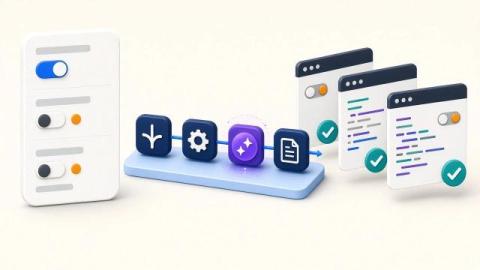
How we automated feature-flag cleanup with Agentic Pipelines

The hard part of a feature flag is rarely adding it. It is remembering to remove it months later, when the rollout is over, the original context has faded, and there is always a more urgent piece of work waiting. Since April 2026, one Atlassian team has used Agentic Pipelines to clean up their monthly backlog of stale feature flags. The workflow prepares the change and opens a pull request, while engineers still review and merge the pull request.

How to improve agent experience (AX) with CI

Improving agent experience (AX) is one thing. Keeping it good as your product changes is harder. A renamed field, different error response, or overlapping tool can turn a workflow that worked yesterday into extra retries, wasted tokens, or human intervention. CI gives teams a way to catch AX regressions as part of the development process. You can test the interfaces agents depend on, run representative agent workflows against product changes, and preserve fixed failures as regression cases.

How Universities and Academic Institutions Use DCIM for Efficiency and Collaboration in Their Data Centers: 3 Real-World Success Stories

Many universities and academic institutions use data centers for a wide range of purposes: secure data storage for student and faculty information, learning management systems, and administrative operations. Universities also use data centers for research and data analysis. Research, simulations, machine learning models, and data analysis all require high-performance compute.