Operations | Monitoring | ITSM | DevOps | Cloud

The latest News and Information on DevOps, CI/CD, Automation and related technologies.

Beyond Mythos: responding to a new threat landscape

Canonical’s security philosophy has always been built on the premise that vulnerabilities exist and will be discovered. Our response relies on defense-in-depth architecture, rapid patch deployment, and strict adherence to Coordinated Vulnerability Disclosure (CVD). AI changes vulnerability discovery volume and speed. We have a robust vulnerability management process that is backed by rigorous compliance certifications.

Shipped: Stop rebuilding Views from scratch

In Explorer, you build a filter set and group-by to answer a cost question, and often that’s exactly the configuration you’d want to save for later. But saving it as a View meant navigating away from Explorer, opening the Views page, and rebuilding the same configuration from scratch: filter by filter, dimension by dimension. That friction was enough to discourage saving exploratory analysis as a View at all You can now save any Explorer analysis as a View in place.

AI pricing explained: what AI actually costs and how providers charge for it in 2026

AI pricing covers the cost structures and billing models providers use to charge for AI products: per-token APIs (GPT-4o at $2.50/1M input tokens), per-seat subscriptions (Copilot at $30/user/month), per-conversation billing (Agentforce at $2/conversation), and consumption-based GPU compute (H100 instances at $55.04/hour). There is no standard. The total AI cost is almost always higher than the sticker price.

8 IT Infrastructure Automation Use Cases to Prioritize

IT infrastructure automation sounds simple enough on the surface, right? You take repetitive infrastructure work, turn it into automated workflows, and give engineers more time for higher-value problems. This may seem easy, but in practice, it gets more interesting. Modern IT environments are spread across cloud platforms, legacy systems, identity tools, ITSM platforms, monitoring systems, network devices, and business-critical applications.

The bottleneck has moved. AI is rewriting the Software Development Lifecycle

If you've read our previous piece on the 8 stages of AI engineering maturity, you know where your team sits. Turns out adopting AI is the easy part; adapting to its consequences is where most organizations struggle. For more than a decade, software organizations optimized around a single assumption: implementation capacity was scarce.

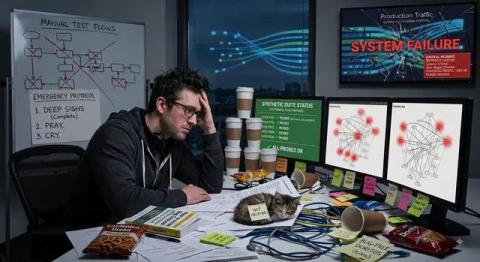
Why CI/CD Pipelines Miss Runtime Failures

CI/CD pipelines do four things: it builds code, runs tests against mocked dependencies, lints for style violations, and scans for known vulnerability patterns. What it cannot do is validate how that code behaves under real users, real service responses, and real runtime constraints that staging was never configured to reproduce. That entire class of failure clears every gate cleanly and surfaces only in production.

Why route diversity is critical to resilient global connectivity

Subsea cables have long been the invisible backbone of the internet, carrying more than 95% of global data traffic beneath the ocean’s surface. Today, they are no longer just background infrastructure, they sit at the centre of an increasingly complex digital and geopolitical landscape. The rise of artificial intelligence, alongside continued cloud expansion and hyperscale data centre growth, is driving unprecedented demand for high-capacity, low-latency connectivity.

LightMesh DHCP Integration: Always Know What's on Your Network

Dynamic Host Configuration Protocol (DHCP) activity changes faster than most IP inventory systems can keep up. Devices reconnect. Leases expire. Infrastructure changes constantly across servers, endpoints, and cloud environments. If your IP inventory cannot reflect those changes automatically, teams quickly lose confidence in the data they rely on to operate the network.

ClickHouse LowCardinality: When It Helps and When It Hurts

ClickHouse LowCardinality cuts storage and speeds up queries on low-cardinality columns, but backfires on trace IDs. How to tell the difference. Prathamesh works as an evangelist at Last9, runs SRE stories - where SRE and DevOps folks share their stories, and maintains o11y.wiki - a glossary of all terms related to observability.