Operations | Monitoring | ITSM | DevOps | Cloud

How to Send Critical Freshservice Tickets to On-Call Staff Instantly (OnPage Integration)

This video demonstrates how the OnPage + Freshservice integration helps IT and support teams respond faster to urgent incidents and critical tickets—without changing their existing Freshservice workflows. Freshservice is often the system of record for incidents and service requests, but dashboards and email alerts aren’t always reliable when something requires immediate, human acknowledgment, especially after hours. That’s where OnPage comes in.

OnPage 2025 Product Updates: Clinical Communication, On-Call Management & Incident Alerting

OnPage 2025 Year in Review | Clinical Communication, On-Call & Incident Response ( What’s New in OnPage (2025): CC&C, On-Call Scheduling & Critical Alerts ) In this video, Ritika from OnPage's Product Marketing, walks through the key OnPage product enhancements released in 2025 across clinical communication & collaboration (CC&C), on-call management, and critical incident alerting. The updates shown here are designed to help on-call teams communicate clearly, reduce alert fatigue, and respond faster during high-priority events.

Unified Observability: What It Is and Why It Matters for Large Enterprises

Modern enterprises operate within a digital ecosystem of staggering complexity - spanning on-premises systems, private and public clouds, APIs, containers and SaaS platforms. Business-critical services often rely on a mix of legacy infrastructure and modern applications, each producing huge volumes of metrics, log messages, traces and events.

Blameless Postmortem: Foundation of Site Reliability

When systems fail, the instinct to find someone to blame runs deep. But what if assigning fault actually makes your systems less reliable? A blameless postmortem culture transforms how teams learn from incidents, creating stronger systems and more effective incident response processes.

Runbooks are history: Why agentic AI will redefine incident response forever

If you’re an SRE, platform engineer, or on-call responder, you don’t need another article explaining incident pain. You feel it every time your phone lights up in the middle of the night. You already know the pattern: You’ve invested in runbooks, automation, observability, and “best practices,” yet incident response still feels like firefighting. Now imagine the same midnight page, but with AI SRE in place: What once took hours is now finished in a couple of minutes.
Sponsored Post

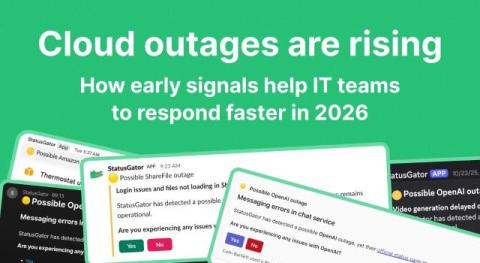
Cloud Outages Are Rising: How Early Signals Help IT Teams Respond Faster in 2026

Cloud outages used to be rare, headline-making events. Today, they're part of the daily reality of running digital operations. Whether triggered by a configuration error, network routing issue, API failure, or global infrastructure disruption, cloud incidents now occur frequently, propagate quickly, and affect more services than ever before. In 2025, one trend has become undeniable: Teams that detect cloud outages early experience less downtime, respond faster to incidents, and avoid unnecessary internal chaos.

What NVIDIA, Okta, and Warner Bros. Discovery Learned About Scaling AI Operations Beyond the Pilot Phase

One key takeaway from AWS re:Invent 2025 was that a clear gap has emerged between teams still experimenting with AI and those seeing measurable value at scale. In two sessions, PagerDuty customers joined us onstage to explain how they’ve scaled pilots into successful AI operations.

99%+ Accuracy on a Moving Target: Model Deprecation and Reliability with Not Diamond

Shipping systems powered by LLMs would be hard enough if the models stayed the same. But in reality, they don’t. Models get updated and deprecated at a pace traditional software wouldn’t. All while teams are still expected to hit reliability targets that look a lot like traditional SLAs.

What Our Customers Say: The Real Value of Incident Response Tools

You’re thinking about implementing an incident response tool, but you’re not quite sure what to look for – or which solution is the right fit? Of course, we could tell you a lot about the benefits of an incident response tool. After all, we’ve been involved with our software from day one and know the thinking behind every feature. But how can you know whether an incident response tool like SIGNL4 will truly work for you in real-world scenarios?

DevEx matters for coding agents, too

The speed at which you can go from making a change in your code, to understanding if it actually works, has long been a popular topic of discussion (and often, humour) for engineers. This remains true in a world with AI. Developer experience isn't just important for humans anymore. Those agents we're all using hundreds of times a day? Feedback cycles matter just as much for them, if not more.

Closing the Year: What 2025 Taught Us About Resilience

By Doreen Jacobi, DERDACK / SIGNL4 It is that time of the year again. Time to reflect and look back at 2025. And I find myself thinking less about platforms and features – and more about the people behind them. The engineers who pick up the phone at 2 a.m. The operators who make judgment calls with incomplete information. The responders who keep systems running when everything feels urgent. If this year taught us anything, it’s this: technology can detect the problem, but people solve it.

2025 founders year in review: insights, highlights, and future plans

Three founders, one kitchen table, and a very honest end of year conversation. In this episode we look back on 2025, from moving continents and growing the company at pace, to ski trips that probably should not have happened, live demos that absolutely could have gone wrong, and the small moments that made the year memorable.

From Downtime to Stability: The Role of Managed IT in Modern Operations

Operational downtime has become one of the most expensive risks modern organizations face. A single system failure can halt workflows, expose security gaps, and drain revenue within hours. And as businesses in Long Beach & beyond grow more dependent on digital systems, the margin for IT failure keeps shrinking. Yet many operations teams still rely on reactive IT models, fixing issues only after they cause disruption.

Top Incident Alerting and On-Call Management Software (2026 Buyer's Guide)

Disclosure: This comparison is written by our product marketing team that works closely with IT operations and on-call workflows. While we build incident alerting software ourselves, this guide is designed to help teams understand how different tools fit different operational needs. We believe there is no single “best” tool. Only the right fit for a given team.

Reliable Alert Notifications - Stay Informed, Stay Ahead

SIGNL4 ensures an automated delivery of your critical alerts from IT, security systems, machines or sensors. Reliability is provided through features like customizable and versatile notification channels, confirmations, proactive and efficient escalation procedures, swift response and real-time alerting, and mobile accessibility to keep you informed anywhere, anytime.

How Forward-Looking Institutions are Benefiting from Agentic AI

Today’s higher education institutions operate complex digital ecosystems that were unimaginable a decade ago. Behind every college lies a portal of interconnected systems for registration, financial aid, course management, and campus services. The students using those systems are digital natives who can order food in seconds on their phones or have packages delivered the same day they order them.

How agentic IT operations lay the foundations for SRE success at scale

When something breaks in a modern digital service, customers feel it instantly. Pages stall, requests time out, and carts are abandoned, while frustration grows long before a root cause is identified. What the world never sees is the engineering effort required to keep these systems healthy in the first place. Site Reliability Engineers (SREs) carry that responsibility every day.

Scrapers Take Down GitHub: December 11 Outage Timeline

On December 11, 2025, GitHub experienced intermittent disruptions that frustrated users across the globe. Developers everywhere started seeing random errors, 503s, unicorns, and CI pipeline failures. Very quickly it became clear something was wrong, even though GitHub’s status page still said ALL SYSTEMS OPERATIONAL. After the incident was over, GitHub published a postmortem that revealed the cause: scrapers. Automated tools hit GitHub with enough traffic to overwhelm key backend systems.

AI Reliability, Part 2: When the Datacenter Becomes the Bottleneck

In Part 1, we talked about all the hidden complexity inside AI systems: the pipelines, GPUs, embeddings, vector databases, orchestration layers, and everything else that quietly determines how reliable an AI-first product really is. But all of that software still rests on something far less glamorous: the physical infrastructure underneath it.

Major Cloud Outages of 2025

Cloud outages in 2025 ranged from minor ones affecting some sections of users, to major ones affecting hundreds or thousands of users. Services like Cloudflare and AWS on which many other services depend experienced outages that affected many due to the cascading effect. Let's look at some of the major cloud outages in 2025.

Microsoft Teams outage - December 10th, 2025

On the morning of December 10, 2025, Microsoft Teams experienced a service disruption affecting users across Australia. Although Microsoft 365 users reported issues across several apps, the hardest hit service was Microsoft Teams which became completely unusable for many organizations. While Microsoft did not acknowledge the incident until 03:46 UTC StatusGator identified the issue at 02:52 UTC through incoming outage reports and delivered an Early Warning Signal at 03:01 UTC.

What Is IT Incident Response?

“We’ve got a new alert – have you seen it yet?”“Which one? The CPU spike or the unusual login?”“The login. Same region as yesterday. But the CPU thing looks suspicious too.”“…Alright, I’ll check the firewall logs. You take the containers.”“Perfect. Let’s hope this doesn’t turn into another all-hands situation.” Does this conversation sound familiar?

Every Business Needs a Robust Incident Response Strategy

In today's digital landscape, businesses face an increasing number of cyber threats that can compromise sensitive data, disrupt operations, and tarnish their reputation. As companies adopt more complex technological solutions, they must be prepared for the inevitable risk of security incidents. Having a well-established, effective incident response strategy is no longer optional but essential. This article explores why incident response solutions are critical for every business and how they play a pivotal role in safeguarding an organization's assets, reputation, and continuity.

When major IT incidents occur, AI can deliver speed and transparency

The recent Cloudflare outage served as a stark reminder of how fragile the global digital ecosystem can be due to a single point of failure. In a matter of minutes, thousands of websites that rely on Cloudflare’s CDN, from Fortune 500 brands to SaaS platforms and consumer apps, went offline for hours. The business impacts were severe, with Shopify alone suffering over $4 million in losses while downstream merchant impacts potentially exceeded $170 million.

New features: AI SRE, Merge alerts, and Status pages for thousands of services

As we head into the holiday season, the ilert team is doing the opposite of slowing down; we’re ramping up. Over the past weeks, we’ve shipped a wave of impactful improvements across alerting, AI-powered automation, mobile app, and status pages. From major upgrades that reshape how teams triage incidents to smaller refinements that remove daily friction, this release is packed with updates designed to make on-call and operations smoother, smarter, and faster. Let’s dive in.

Shopify Outage 2025: Rise of the Commerce Kaiju

It was a normal day in the land of eCommerce. Birds were singing, dashboards were loading, and merchants everywhere felt cautiously optimistic. Then the ground trembled. A tiny glitch. A flicker. A warning log no one read. And suddenly— BOOM! Shopify burst out of the digital ocean like a gigantic scaly beast that woke up on the wrong side of the server rack. Checkouts froze mid-purchase. Product pages stopped producting. Merchants stared blankly at blank screens. The Commerce Kaiju had arrived.

Cloudflare was down again: Here's what happened.

On December 5, 2025, the internet faced another major disruption – the second significant Cloudflare-related outage in just a few weeks. A similar widespread incident occurred on November 18, which we covered in detail in our post The internet broke again – StatusGator can help. Today’s outage reinforces how quickly issues within core internet infrastructure can ripple outward and impact thousands of services simultaneously.

Towards a more resilient StatusGator

Between October 20 and December 5, 2025, a rapid succession of major outages across multiple cloud providers disrupted large portions of the internet. Each of these events affected StatusGator in different ways. After each incident, we implemented improvements to strengthen our reliability. This post summarizes the impact of each outage, the changes made, and the architectural work now underway to ensure StatusGator remains available during the moments when it is needed most.

Introducing the BigPanda Triage Agent and the future of agentic L1 operations

If you’ve been following the development of BigPanda AI Detection and Response (ADR), you’re aware of our mission to automate Level 1 (L1) operations and eliminate the need for manual, time-consuming investigations. In our last update, we highlighted the manual, complex, and time-consuming processes that hinder modern IT teams. Enterprises spend billions on observability tools based on the false belief that more coverage equals total visibility.

PagerDuty Becomes Newest AWS Software Partner to Earn Resilience Competency

As enterprise system failures cost businesses an estimated $400 billion annually in lost revenue and productivity, PagerDuty announced it has achieved the Amazon Web Services (AWS) Resilience Services Competency in the software category - becoming one of the first AWS Software Partners to earn the designation. This achievement validates PagerDuty's ability to help enterprises architect, deploy and maintain mission-critical systems that can withstand failures and recover rapidly with minimal business disruption.

From Noise to Notified: Making Azure Sentinel Alerts Actionable

Modern security operations are overflowing with data, and organizations rely heavily on Azure Sentinel alerts and Microsoft Sentinel alerts to maintain visibility across hybrid environments. From firewalls and endpoints to cloud workloads and identity systems, thousands of signals compete for attention every second. For most security teams, the challenge isn’t detection anymore – it’s action.

Turning Incidents Into Insight: The Continuous AI Operations Loop Explained

Modern systems generate enormous volumes of operational data. Yet, most incident workflows still treat every outage like a one‑off fire drill: an alert fires, responders scramble, the issue is resolved, the status page goes green—and the organization learns almost nothing from the experience. Meanwhile, the same patterns quietly repeat in code releases, logs, traces, and support tickets until they erupt into the next ‘unexpected’ incident.

Shopify Cyber Monday outage - December 1, 2025

On December 1, 2025, Cyber Monday, the biggest online shopping day of the year, Shopify suffered a widespread outage that left many merchants unable to access their stores or process orders. At a time when every minute of uptime translates directly into revenue, the disruption caused immediate concern across the ecommerce community. StatusGator detected the issue within minutes, sending an Early Warning Signal 10 minutes before Shopify published its official acknowledgement.

Introducing a More Flexible On-Call Schedule

Today, we are introducing some new on-call features: Add Gaps to on-call, Scheduled Layers, Handoff Days, and more. Flexibility in on-call schedules has been the single focus point in this release. These features give you much finer control over when people are on-call, how handoffs work, and what your schedule looks like around holidays and time off.

AI agents just got smarter thanks to PagerDuty + AWS

We are on the ground with AWS and announcing innovations that give customers more powerful AI agents for incident management. These new and improved integrations bring PagerDuty context into the AWS ecosystem for faster resolution and more connected data across the business. And, with our new competency, we take this a step further by codifying these best practices into our joint customers’ day-to-day operations. Announced today, here are some of the highlights.

OnPage Introduces Multi-Language Mobile App Localization on iOS & Android

As organizations continue to adopt OnPage across regions and operational environments, providing an experience that feels natural and intuitive for every user has become increasingly important. Clear communication is essential in time-sensitive workflows, and being able to use the app in one’s preferred language supports clarity, confidence, and consistency. To support our growing global user base, OnPage is introducing multi-language localization across its mobile applications.

How ilert's holidays and support hours keep teams sane

The end of the year brings pressure. (Oh, we know!) Customer demand spikes, response expectations stay high, and engineering teams are juggling production issues, releases, and time off. For many teams, this is when on-call becomes chaotic: schedules break, notifications hit at the wrong time, and coverage gaps appear exactly when you can’t afford them. ‍ ilert's Holidays and Support hours features were built to fix that.

AI Infrastructure Is Creating a New Wave of Incidents, And Why Enterprises Need a Modern On-Call Strategy

Over the last few years, AI has quietly shifted from a fascinating experiment to a core operational system. Enterprises aren’t just building prototypes anymore — they’re deploying LLMs into production environments where uptime directly affects customer interactions, revenue flows, and business continuity. AI has essentially become a new layer of critical infrastructure. Because of that shift, the definition of “reliability” is changing.

Stop choosing between fast incident response and secure access

Every production system will eventually break. It's not pessimism, it's just reality. That's why engineers go on-call, and why companies invest heavily in incident response tooling. But here's the problem: the moment an engineer goes on call, they typically need elevated access to production systems, databases, and sensitive customer data. And that elevated access? It's often permanent, overly broad, and a security nightmare waiting to happen.