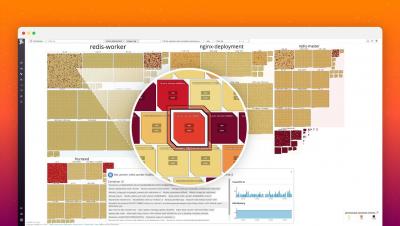
Introducing the Container Map
Datadog's new container map allows you to group, filter, and visualize all your containers on the fly, at any scale.


The latest News and Information on DevOps, CI/CD, Automation and related technologies.
As an open-source system for automating deployment, scaling, and management of containerized applications, Kubernetes has grown immensely in popularity. Increasingly, we are also beginning to come across platforms offering Kubernetes as both a hosted and managed service.
DevOps is no longer just about breaking the silo between developers and operations. That’s why every manual operation in your delivery pipeline needs to be evaluated to determine if it can be automated. Database changes are indeed a tedious process and therefore deserve to be considered in your DevOps implementation.
If you’re starting out a new project, don’t start with the Log In page [citation needed]. This is definitely not your core feature and there are a lot of other things to start out with. I know, it’s a cliche, but most developers want to start with the Log In page.
Supporting a growing software team is a daunting challenge, and Git is often at the heart of that task. Ensuring developers can effectively collaborate requires user provisioning, tool permissions, and enough horsepower to support all of the load. If you support a distributed team, the factors become more complex. How do you ensure developers have a consistent experience across geographies and help productivity flourish?
Microsoft recently released Azure Kubernetes Service (AKS), a managed service that helps you deploy, run, and scale Kubernetes clusters. We’re pleased to share that Datadog’s integrations with Kubernetes and Azure Monitor can give you comprehensive visibility into your AKS infrastructure with no additional configuration.
You know what’s not fun for DevOps engineers? Manually investigating and troubleshooting issues within their applications. It’s also no longer feasible in today’s highly complex and fast moving IT landscape. Gone are the days of using legacy on-premises tools for modern applications and infrastructures because they simply aren’t compatible.
Terraform is an open source orchestration tool for provisioning, managing, and versioning cloud infrastructure. Terraform uses a configuration file as a blueprint of the desired infrastructure state, and changes the target environment by updating or creating resources to match the defined state. Having a defined outline of your datacenter and following this “infrastructure as code” model allows for repeatable automation.