The latest News and Information on DevOps, CI/CD, Automation and related technologies.
In Kubernetes, Ingress objects define rules for how to route a client’s request to a specific service running inside your cluster. These rules can take into account the unique aspects of an incoming HTTP message, including its Host header and the URL path, allowing you to send traffic to one service or another using data discovered in the request itself. That means you can use Ingress objects to define routing for many different applications.
At Elastic, we believe in the power of open source and understand the importance of community. By putting the community first, we ensure that we create the best possible product for our users. With Elastic Security, two of our core objectives are to stop threats at scale and arm every analyst. Today, we’re opening up a new GitHub repository, elastic/detection-rules, to work alongside the security community, stopping threats at a greater scale.
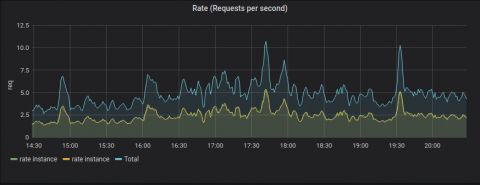
Lately we’ve been working on improving different parts of the Mattermost server, including our monitoring and observability capabilities. We’ve been using Prometheus and Grafana to monitor our cluster for a while now, and you can read this great post where my colleague Stylianos explains how we have them working for our multi-cluster environment.
At Elastic we are constantly innovating and releasing new features. As we release new features we are also working to make sure that they are tested, solid, and reliable — and sometimes we do find bugs or other issues. While testing a new feature we discovered a Linux kernel bug affecting SSD disks on certain Linux kernels. In this blog article we cover the story around the investigation and how it involved a great collaboration with two close partners, Google Cloud and Canonical.
Everyone hates waiting in a queue. On the other hand, when you’re moving gigabytes of data around a cloud environment, message queues are your best friend. Enter Apache Kafka. Apache Kafka enables organisations to create message queues for large volumes of data. That’s about it – it does one simple but critical element of cloud-native strategies, really well.
Many enterprises have already adopted Kubernetes or have a Kubernetes migration plan in place, making it clear that the platform is here to stay. While it provides a lot of benefits to its users, to take advantage of them, you need to thoroughly learn Kubernetes and how it works in production. Typically, the most difficult aspects of Kubernetes are learned through experience solving real-world problems.
Velocity, much like the pulse rate or oxygen level of an individual, is an important measure of health for your development team. A low velocity score for recent sprints limits your team's options for delivering value. Sustained failure to deliver to stakeholders can erode trust with those stakeholders quickly. But how do you know exactly what your velocity is and how you can improve it?