Operations | Monitoring | ITSM | DevOps | Cloud

The latest News and Information on DevOps, CI/CD, Automation and related technologies.

When Disaster Strikes: Ensuring Your DRP Actually Works

Black swan events are inherently unpredictable—you can’t prepare for every possible threat. Instead, you must identify the ways systems can fail and develop strategies to restore them to full service when these failures happen. But a disaster recovery plan (DRP) can’t be relied on until it’s been proven to work. The use of Chaos Engineering allows you to test your DRP much more safely and predictably than you could otherwise.
SRE's Guide to Chaos & Observability

Today’s distributed, cloud-based environments are incredibly complex. Not only does each component depend on many others, but modern systems are also highly dynamic—changing frequently as teams push new code or make updates to infrastructure. Taming this complexity to ensure reliability requires end-to-end observability to understand how components depend on each other. Additionally, proactive Chaos Engineering combined with AI-driven observability lets you uncover “unknown unknowns” that impact how your system will respond to different failure scenarios.

Building Reliable Applications Webinar 6 17 21

Test-driven development (TDD) is a process that ensures quality in the applications we develop while guarding against feature creep/skew. But as our applications have become increasingly complex, traditional testing methods are not enough. Traditional testing only evaluates what we know, but complex systems often fail due to unknowns—the things that are almost impossible to test because we are unaware of them. Chaos Engineering is the exception that allows us to test for what we don’t know.

Dissecting DevOps - Measuring quality in a SaaS world: SLA, SLI, SLO

Now that software is delivered over the web and not in a box, how developers guarantee quality to their users has radically changed. Users do not care about version numbers or floppy disks. They just want access to a service that just works. In the microservices world, the quality of your service both to your internal users and external is measured by SLAs, SLIs, and SLOs. And how you decide what those metrics are is a key strategy.

GitLab Client for Linux

Working in a DevOps field, I often find myself needing to deliver a feature or an improvement (basically a piece of code) in a relatively short amount of time, or even working in parallel on different tasks. A rather universal software development stack is comprised of: Repository and branch management in Git has never been easier. Get more control over your Git workflow with the visualization offered by GitKraken.

LaunchDarkly Integration: Feature Flag Aware Troubleshooting

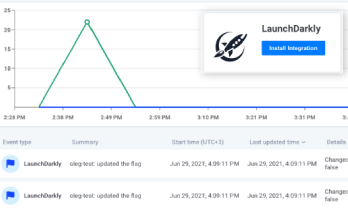
Troubleshooting is the understanding of changes within the system and their impact on its health, behavior, and functionality. However, as dev environments grow exponentially more complex, the definition of “the system” itself also constantly expands. To keep pace, we constantly work to evolve Komodor’s platform and enrich it with new capabilities and integrational options.

The Secret to a Successful Hybrid Application Migration

Planning a hybrid application migration? There’s plenty to deal with already, and now your manager wants to know—how are you going to make sure that the migration is a success? The secret is to take a subjective judgment and turn it into an objective one. As you probably know, there is no way that you can guarantee a problem-free migration. Don’t leave it up solely to how your boss or anyone else feels about the migration.

GitOps meets AppOps

Kubernetes allowed us to manage application deployments and infrastructure components using declarative configuration files (yes, those YAMLs that you may not be a fan of ). While dealing with a myriad of YAML files may be loved by some and hated by others, it enables us to host all these files into a Git repository, hook it up to a pipeline (Jenkins, GitLab, etc.), and have a tool apply those changes to a cluster—and voilà, you have GitOps.