Operations | Monitoring | ITSM | DevOps | Cloud

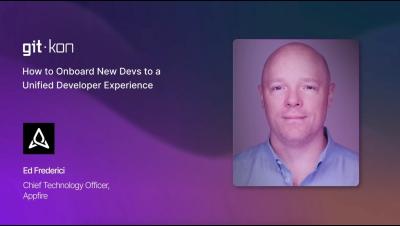
Why Appfire's Onboarding Process is So Fast

How do you onboard 800+ developers, integrate 17 acquisitions, and still keep dev velocity high? Ed Frederici, CTO of Appfire, shares how their unified developer experience scales productivity and preserves team culture. Whether you're leading a team or just joining one, this talk will change how you think about onboarding, autonomy, and dev growth. GitKraken Desktop: gitkraken.com/git-client GitKraken CLI: gitkraken.com/cli.

Core Values for a Better Developer Experience

What does dev onboarding look like after 17 acquisitions? At Appfire, it's not chaos, it's a unified developer experience that actually scales. In this GitKon session, CTO Ed Frederici shares how Appfire integrates 60+ teams and 160+ products without losing developer velocity or culture. For dev leads, managers, and anyone building a better onboarding playbook...this one's gold.

Stop Scrolling Through Git History Forever!

Trying to find when a specific function changed — or disappeared? In this episode of Wait… Git Can Do That?, we show you how to use git log -S'string' to search your Git history for code-level changes. Use -S to find string adds/removals Add -p to view the diffs Bonus: In GitKraken Desktop, search visually and jump straight to changes Less guessing.

The AI Monitoring crisis that no one's talking about

When I spoke at AWS London earlier this year, I had the chance to discuss something that more and more teams are starting to feel: traditional observability doesn’t cut it for AI systems. In AI, “Is it running?” is no longer enough. We have to ask, “Is it right?” When I delivered that line, I saw the heads nodding. Everyone’s excited to build with LLMs, but when it comes to actually monitoring them in production? That’s where things fall apart.

Autonomous Operations Are Here

ScienceLogic’s vision for IT operations isn’t just about improving tools—it’s about changing the entire paradigm, flipping your day-to-day upside down. We’re moving beyond dashboards and alerts, beyond human-only workflows and rules-based systems. The future is autonomous. It’s intelligent. It’s agentic. And it’s already being realized through the power of Skylar AI.

IT Service Performance Monitoring: Key Metrics, Best Practices, and Future Trends

As organizations rely more on complex IT systems and cloud-based services, keeping everything running smoothly — and reliably — has become a top priority. That’s where IT service performance monitoring comes in, giving teams the visibility they need to make sure systems stay healthy and responsive. By tracking a range of technical and user-focused metrics, businesses can quickly identify and address issues before they impact operations or end users.

Build Smarter With Cloud-Native Tools: Your 2025 Guide

Cloud-native tools promise speed, scalability, and resilience. The catch is you have to pick the right ones and use them well. Without the right foundation, they can mean more complexity, hidden costs, and a false sense of control. In this guide, we’ll help you avoid that trap. From infrastructure to observability and CI/CD tools, we’ll cover the solutions shaping modern cloud stacks.

The Hidden Cost of Not Using APM in Production

Many organizations don’t realize how important it is to monitor how their applications run in production. Without Application Performance Monitoring (APM), it becomes difficult to detect and resolve issues quickly, leading to increased downtime, wasted developer effort, and poor user experience. These hidden costs, though not always visible at first, can impact customer satisfaction, reduce team efficiency, and result in lost revenue.

From Chaos to Control-How PagerDuty and AWS Are Protecting Business Continuity

The recent outage on June 12 proved yet again that service disruptions are inevitable, it’s not a matter of if, but when? And the next question is: how ready are you when that disruption strikes? What sets successful leaders apart is how quickly they are able to recover. Digital businesses are more complex than ever. Teams are managing sprawling cloud environments, microservices architectures, and a dizzying array of third-party integrations.