Operations | Monitoring | ITSM | DevOps | Cloud

What Is Cloud Forecasting And How To Do It Right

One of the cloud’s greatest advancements is its ability to scale resources like vCPU and memory based on demand. However, this auto-scaling can also lead to unexpected cost fluctuations — sometimes subtle, sometimes dramatic — especially with new or unpredictable workloads. That’s why cloud forecasting is essential. It helps you stay ahead of unpredictable costs by aligning your spending with business goals. How? We’ll break down how cloud cost forecasting works.

Why Mobile Asset Management Is a Game Changer for Field Services?

FSM is quite important for businesses today. Jobs included in FSM include installing, maintaining, and repairing services that are done away from the main office. To overcome the challenges of field service work, businesses need reliable tools to make processes better, reduce costs, and raise customer satisfaction. This is where Asset Infinity makes a difference with a new solution designed to address the issues related to managing field assets effectively and efficiently.

The Importance of Reporting & Dashboards in Asset Management

In the evolving and changing business landscape that demands the management of assets, availing them in support to operational success is associated with immense basic asset management need. It is no longer around tracking and maintaining assets but is about providing organizations within actionable insights useful to optimize usage, reduce costs, and thus improve decision-making.

Making sure you get a Checkly alert for every detected failure

It’s every ops team’s biggest anxiety: a monitoring system detects a failure, but the notification either isn’t delivered or isn’t noticed by the team. Now we have to wait for users to complain before our team knows about the problem. Checkly sends an alert every time the system detects a failure, but how can you be sure you’re getting those alerts, and that those alerts are going to the right people?

How to Use OpenSearch with Python for Search and Analytics

If you're working with search and analytics, you’ve probably heard about OpenSearch—the open-source alternative to Elasticsearch. OpenSearch is a powerful tool, whether you're building a search engine, running log analytics, or implementing full-text search in your applications. And the best part? You can integrate it easily with Python.

OpenTelemetry Visualization Setup: A Developer's Guide

If you've ever tried to set up OpenTelemetry visualization, you know it can be a bit overwhelming. But don't worry—in this guide, we'll break it all down step by step. Whether you're just getting started or looking to fine-tune your existing setup, this walkthrough will help you get the most out of your telemetry data.

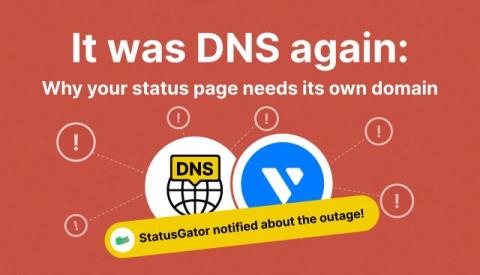
It was DNS Again: Why Your Status Page Needs Its Own Domain

On February 20, 2025, at 16:22 UTC, StatusGator detected an outage affecting Vultr. The issue appeared to stem from a DNS failure, causing vultr.com and any other services hosted on its domain to become inaccessible. But what does that include? The official Vultr status page. Because Vultr hosts its status page on status.vultr.com, the same domain hosting its primary website and dashboard, users were left without an official source of updates during the outage.

Getting Ready with Regex 101

If you’ve dropped your house key in tall grass, you know how difficult it is to locate a small item hiding in an overgrown field. Perhaps, you borrowed a metal detector from a friend, then returned to the field hoping to get the loud beep that indicates finding metal in an otherwise organic area. Trying to find patterns in strings of data is the same process.

Guide To Confluent Kafka vs Apache Kafka

Kafka is an open-source distributed streaming platform for high-throughput and fault-tolerant real-time data streaming in large-scale systems. It can integrate with a wide range of data sources and sinks, which include databases, message queues, big data processing frameworks like Apache Spark and Apache Flink, and many more.

How to make APIM log data easily accessible for non-technical users?

This video explains the use case for API Management and Integration using the Business Activity Monitoring (BAM) feature of Turbo360. The scenario involves tracking help desk ticket submissions via an API, ensuring that support teams and business users can easily check the status of tickets. The challenge is that log data is complex and not easily accessible to non-technical users. Turbo360 simplifies this by providing a user-friendly interface where support teams can search, filter, and analyze logs without deep technical expertise.