On-Call Schedules and Alert Escalation with PagerTree
PagerTree intelligent on-call alert routing gives teams flexible schedules, escalations, & reliable notifications via email, SMS, voice, chatbots, & smartphone app.


At the core of the LogicMonitor solution, there is the LogicMonitor Collector. The Collector is a small Java app installed on servers in your environment that collects monitored data from your various devices and then sends that data to LogicMonitor for retention and display. The Collector is what connects your environment to the cloud and allows you access from anywhere. However, sometimes these Collectors can go down, potentially leading to gaps in monitoring.
We've all worked with tightly-coupled code. If a butterfly flaps its wings in China, the unit tests break. Maintaining a system like this is...unpleasant. In this article, Jonathan Miles dives into the origins of tight-coupling. He demonstrates how you can use dependency injection (DI) to decouple code. Then he introduces a novel decoupling technique based on delegation that can be useful when DI is not an option.
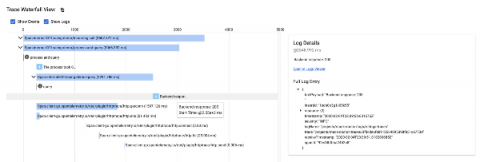
One of the main benefits of using an all-in-one observability suite like Stackdriver is that it provides all of the capabilities you may need. Specifically, your metrics, traces, and logs are all in one place, and with the GA release of Monitoring in the Cloud Console, that’s more true than ever before. However, for the most part, each of these data elements are still mostly independent, and I wanted to attempt to try to unify two of them — traces and logs.
Using dashboards in Stackdriver Cloud Monitoring makes it easy to track critical metrics across time. Dashboards can, for example, provide visualizations to help debug high latency in your application or track key metrics for your applications. Creating dashboards by hand in the Monitoring UI can be a time-consuming process, which may require many iterations. Once dashboards are created, you can save time by using them in multiple Workspaces within your organization.
Serverless applications, due to their distributed nature, are often stuck having to reinvent the wheel. While small utility scripts and functions are often easily instrumented and monitored, anything of a transactional nature will need to implement special code to provide developers with common tools like stack traces, atomicity, and other patterns that rely on a singular flow of control.
Making sure that your ElastAlert yaml file is formatted and configured correctly. All of the below points will prevent alerts from being fired but there may not be an error message associated with the problem. It is possible you may need to contact support to investigate this issue for you. Make sure to proof read the rule you have written to ensure that it is what you expect to see as most of the issues regarding ElastAlert not working correctly is related to the points above.
In the Data Age 2025 report, worldwide data is expected to grow 61% to 175 zettabytes by 2025. The enterprise sector, in particular, generates more than 30% each year. To be ready for a digital future, consider the scaling strategy of data infrastructure beforehand. Scale-up and scale-out are the main ways to add capacity to your infrastructure.