
Operations | Monitoring | ITSM | DevOps | Cloud

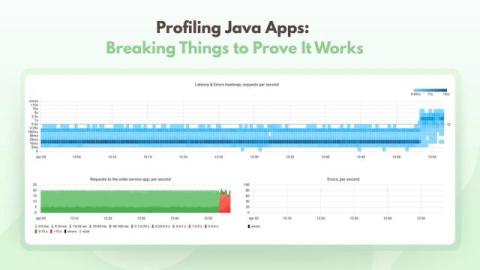
Profiling Java apps: breaking things to prove it works

Coroot already does eBPF-based CPU profiling for Java. It catches CPU hotspots well, but that's all it can do. Every time we looked at a GC pressure issue or a latency spike caused by lock contention, we could see something was wrong but not what. We wanted memory allocation and lock contention profiling. So we decided to add async-profiler support to coroot-node-agent. The goal: memory allocation and lock contention profiles for any HotSpot JVM, with zero code changes. Here's how we got there.

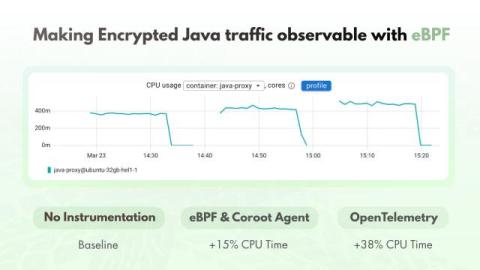
Making encrypted Java traffic observable with eBPF

Coroot's node agent uses eBPF to capture network traffic at the kernel level. It hooks into syscalls like read and write, reads the first bytes of each payload, and detects the protocol: HTTP, MySQL, PostgreSQL, Redis, Kafka, and others. This works for any language and any framework without touching application code. For encrypted traffic, we attach eBPF uprobes to TLS library functions like SSL_write and SSL_read in OpenSSL, crypto/tls in Go, and rustls in Rust.

Spring Boot API Testing: A Practical Guide for Enterprise Teams

Enterprise Spring Boot APIs should be tested at three levels: unit tests for business logic, integration tests for external service behavior, and traffic replay for production edge cases. Most teams only do the first. This guide shows all three using a real Spring Boot application that calls external APIs (SpaceX, US Treasury) with JWT authentication. The kind of service that looks simple in development and breaks in production.

Enable end-to-end visibility into your Java apps with a single command

Achieving end-to-end observability for applications is a top priority for organizations today, but instrumenting for both frontend and backend monitoring can be a significant hurdle. What complicates matters is that the SREs and DevOps teams responsible for deploying monitoring tools typically don’t own frontend code or have the context needed to safely modify it.

Oracle JDK to OpenJDK: A Guide to Reliable Migration Testing

One of the most common infrastructure changes Java developers and operators are dealing with today is the migration from Oracle Java to OpenJDK. The reason is the licensing changes made by Oracle and the maturity of the OpenJDK distributions. The migration process is quite simple: replace the JDK, recompile the code, and redeploy the application. However, the differences between the two runtimes can lead to unexpected issues that are not caught by unit tests.

Most Popular Java Web Frameworks in 2026

Look, if you're starting a new Java web project in 2026, you should probably just use Spring Boot. With 14.7% usage in the 2025 Stack Overflow Developer Survey and a 53.7% admiration score among all web frameworks, it remains the default choice for modern Java web development. It has the largest ecosystem, best documentation, most active community, and strongest cloud-native support—now enhanced with built-in AI capabilities through Spring AI.

How to Monitor Java Applications on Windows with SolarWinds Observability | APM Setup Guide

This video provides a step-by-step walkthrough for configuring monitoring for Java applications running on Windows using SolarWinds Observability. The demonstration covers the complete process—from adding a new service to instrumenting the application with the Java APM library and verifying connectivity. Topics covered in this video include: This guide is designed for developers, DevOps engineers, and system administrators who need to instrument Java applications on Windows for performance monitoring, distributed tracing, and full-stack observability.

A deep dive into Java garbage collectors

Historically, developers have relied on languages like C and C++ for explicit control over memory allocation and deallocation. This approach can yield very low overhead and tight control over performance, but it also increases complexity and risk (e.g., memory leaks, dangling pointers, and double frees). This often results in runtime issues that are difficult to diagnose, which can become a drag on team velocity.

Top 11 Java APM Tools: A Comprehensive Comparison

Are your Java applications running at their optimal performance, or is there room for improvement to make them faster and more efficient? With so many services depending on Java, keeping applications responsive and reliable is a core part of modern software engineering. This blog walks you through the leading Java Application Performance Monitoring (APM) tools, with a clear comparison to help you choose the right option for your needs.

Integrating JMX and OpenTelemetry

The OpenTelemetry community and the contributors to the Java Special Interest Group (SIG) have spent a great deal of time integrating core Java technologies into the project. An integration that is particularly useful is Java Management Extensions (JMX). It has been around since J2SE 5, and has been mature for some time. Many of the most widely used Java applications have adopted it over time and support this extension.